Last updated: 25 September 2026

Hire AI Developers

SoluLab lets you hire pre-vetted AI developers on a full-time, part-time, or hourly basis, with onboarding in as little as 1 day to 2 weeks. Our 250+ in-house engineers specialize in machine learning, computer vision, NLP, and deep learning, backed by $40M+ in delivered AI projects and 11+ years of experience across 500+ global clients.

  • Experience in developing 100+ AI products
  • Strict NDA signed to ensure privacy
  • Trusted by INC 500 companies
  • Agile and Lean project execution process
View Portfolio →

What AI Development Services Does SoluLab Offer?

SoluLab's AI developers build machine learning, computer vision, NLP, and automation systems for startups, SMBs, and enterprises. Every engineer you hire works on your roadmap and inside your tools, from the first model to production deployment. Explore our full AI development services if you need a complete project team.

AI Application Development

AI Application Development

Hire AI engineers who turn an AI app idea into a working product. They scope the use case, pick the right model, build the application, and deploy it to your cloud, with regular demos, so you see progress every sprint.

Computer Vision

Computer Vision

Our computer vision developers build models that read images and video: defect detection on production lines, document and ID scanning, shelf monitoring, and medical image analysis. They handle the full pipeline, from data labeling and model training to running inference on cloud or edge devices.

Chatbots and NLP

Chatbots and NLP

Using chatbots produced by our AI specialists, you can swiftly respond to client inquiries and maintain their interest. Our chatbots are equipped with cutting-edge NLP technology, allowing them to tailor their replies to each user.

Recommendation Systems

Recommendation Systems

Recommendation systems suggest the next product, article, or offer each user is most likely to want. Our AI developers build them with collaborative filtering, content-based models, and real-time behavior signals, then measure the lift through A/B tests so you know what the system is worth.

Predictive Analytics

Predictive Analytics

Predictive models forecast demand, churn, fraud, and risk from your historical data. Our AI developers clean and prepare the data, train and validate the models, and connect the predictions to the dashboards and workflows your team already uses.

Speech Recognition

Speech Recognition

Our AI developers build speech recognition and voice interfaces that turn spoken commands into actions: voice search, call transcription, meeting notes, and hands-free controls. They tune models for your accents, vocabulary, and background noise.

Automate Tasks With AI

Automate Tasks With AI

AI developers can automate tasks that eat up staff hours: invoice processing, ticket routing, data entry, and report generation. They combine machine learning, NLP, and workflow tools so documents and requests move through your systems without manual handling.

AI Technologies We Serve

Nvidia Caffe
PyTorch
PyTorch
Keras
Keras
Caffe2
MXNet
Theano
Chainer
Microsoft Cognitive Toolkit
Core ML
Core ML
Kurentos Computer Vision Module
EfficientNet
Inception
ResNet
VGGNet
CNN
CNN
RNN
RNN
Representation Learning
Variational Autoencoders
Manifold Learning
Manifold Learning
Bayesian Networks
Bayesian Networks
Autoregressive Networks
OpenNN
OpenNN
Neuroph
Neuroph
Sonnet
Sonnet
Tensor2Tensor
Tensor2Tensor
Tf-Slim
Tf-Slim
TensorFlow
TensorFlow
Supervised/Unsupervised Learning
Clustering
Clustering
Metric Learning
Metric Learning
Few-Shot Learning
Few-Shot Learning
Power BI
Power BI
Tableau
Tableau
Python
Python
R
R
Java
Java
Jupyter
Jupyter notebooks
Anaconda
Anaconda
Google Colab
Google Colab
Hadoop
Hadoop
Spark
Spark
NoSQL
NoSQL
Docker
Docker
Kubernetes
Kubernetes
AWS
AWS
Cloud
Google Cloud
Azure
Azure
AI CTA Background

Need an AI Developer Who Has Shipped to Production?

Tell us your use case. We'll send vetted profiles, and you interview the shortlist before anyone starts.

Talk to AI Developers

What Makes Our AI Developers Different?

Most AI hires can train a model. Fewer can take one to production and keep it accurate once real users arrive. Our developers are screened for that second skill: they have shipped machine learning, computer vision, and NLP systems, and they work inside your repositories, sprints, and cloud accounts from day one. Here is what they bring:

  • End-to-end model delivery: from data preparation and training to deployment, monitoring, and retraining.
  • Predictive analytics and forecasting: demand, churn, fraud, and risk models tied into the dashboards your team already uses.
  • MLOps and AI infrastructure: versioned models, CI/CD for training pipelines, and drift alerts, so accuracy doesn't erode quietly.
  • Enterprise integration: models connected to your ERP, CRM, data warehouse, and internal APIs, not left in a notebook.
  • Workflow automation: document processing, ticket routing, and data entry handled by AI instead of staff hours.
  • Security and compliance: access-controlled environments, signed NDAs, and IP assigned to you from the first commit.
  • Reporting you can act on: daily, weekly, or monthly updates plus demos every sprint.

Why Choose SoluLab To Hire AI Developers?

The efficiency with which our development team works at SoluLab calls for work experience with them. Hire AI programmers from SoluLab today to get work experience like never before.

High-quality services
Technical expertise
Cost-effective solutions
Manual and tool testing
Timely delivery of projects
Hassle-free client interactions

What Technical Skills Should a Highly Skilled AI Developer Have?

A qualified AI developer combines strong engineering with a working grasp of data and models. These are the technical skills we test for, and the ones you should look for in any AI hire.

Computer Science Foundation

A degree or equivalent grounding in computer science: data structures, algorithms, and system design. It's what separates developers who can ship a reliable production system from those who can only run a notebook.

Strong Programming Skills

Fluency in Python, the default language for AI work, plus Java, C++, or R where a project needs them. Clean, tested code matters as much as model accuracy.

Knowledge of Machine Learning

Hands-on experience with supervised and unsupervised learning, including regression, decision trees, and clustering, and the judgment to pick the simplest model that solves the problem.

Deep Learning & Neural Networks

The ability to design and train neural networks for deep learning tasks such as computer vision and natural language processing (NLP), including CNNs for images and transformer models for text.

Experience With TensorFlow & PyTorch

Production experience with TensorFlow and PyTorch, the two most widely used deep learning frameworks, plus Keras and scikit-learn for faster prototyping and classical machine learning.

Mathematics and Statistics

Artificial intelligence developers should be well-versed in linear algebra, calculus, probability, and statistical inference.

Working With Large Datasets

Experience building data pipelines that clean, label, and move large datasets, using tools like Apache Spark, Hadoop, and cloud data warehouses. Most AI projects succeed or fail on data quality, not the model.

Prompt Engineering & LLM Skills

For projects built on large language models, developers need prompt engineering, retrieval-augmented generation (RAG), and evaluation skills. For LLM-heavy projects, see our dedicated generative AI developers.

Interview Questions to Ask Before You Hire an AI Developer

A good AI developer interview tests judgment, not memory. Anyone can recite what a transformer is. What you need to know is whether the candidate has shipped a model that real users depend on and can explain the trade-offs they made. Use these eight questions, and listen for specifics.

01

Walk Me Through an AI Model You Took to Production. What Broke?

This is the most revealing question you can ask. A strong answer names the business problem, the data, the model, and at least one thing that failed after launch: data drift, latency, a label error, or a user behavior nobody predicted. Then they explain the fix. A weak answer stays in the notebook stage and never mentions deployment, monitoring, or users.

02

How Do You Choose Between a Simple Model and a Deep Learning Model?

Strong candidates start simple. They'll try logistic regression or gradient-boosted trees first, measure the result, and move to deep learning only when the data (images, audio, free text) or the accuracy gap justifies the extra cost. Be wary of anyone who reaches for a neural network by default. It usually means higher compute bills and a model nobody can explain.

03

How Would You Handle a Dataset That's Too Small or Badly Labeled?

Most real projects start here, so this answer matters. Listen for concrete tactics: auditing a sample of labels, cleaning or relabeling the worst classes, data augmentation, transfer learning from a pretrained model, or active learning to label the most useful examples first. A good developer also tells you honestly when the data can't support the model you want.

04

How Do You Measure Whether a Model Is Good Enough to Ship?

Accuracy alone is the wrong answer. A strong candidate picks the metric that matches the business cost of mistakes: precision when false positives are expensive, recall when misses are, and latency or cost per prediction when scale matters. They'll also mention testing on a held-out set that looks like real production data, and agreeing on a pass threshold with the business before training starts.

05

When Would You Use TensorFlow Versus PyTorch?

There's no single right answer, and a good candidate says so. Expect reasoning like this: PyTorch is the default for research and most new model work because it's easier to debug, while TensorFlow still fits teams with existing TensorFlow Serving or TensorFlow Lite deployments on mobile and edge devices. What you want is a developer who picks tools based on your stack, not personal habit.

06

How Do You Monitor a Model After Launch and Catch Drift?

Models degrade quietly as real-world data shifts. A strong answer covers logging predictions and inputs, tracking input distributions against the training data, watching accuracy on a labeled sample over time, and setting alerts that trigger retraining. Candidates with MLOps experience will name tools such as MLflow, Evidently, or their cloud provider's monitoring service. Silence on this topic means they've never owned a live model.

07

For an LLM Feature, When Would You Use Prompt Eng., RAG, or Fine-Tuning?

This separates developers who have built LLM products from those who have only used ChatGPT. A good answer: start with prompt engineering, add retrieval-augmented generation (RAG) when the model needs your own documents or current data, and fine-tune only when you need a consistent style or format that prompting can't deliver. They should also mention how they'd evaluate output quality before release.

08

How Would You Explain This Model's Output to a Non-Technical Stakeholder?

Your AI developer will present to managers, compliance teams, and customers, not just engineers. Ask them to explain a past model in two minutes, without jargon. Strong candidates talk about inputs, outcomes, and limits in plain language, and can say why the model made a specific decision. If they can't make it clear to you, they won't make it clear to your board either.

AI CTA Background

Want to skip the screening? SoluLab's AI developers have already passed technical and behavioral interviews, and you still interview your shortlist before anyone starts.

Book a Strategy Call

SoluLab vs. In-House vs. Freelance: Which Is Better for Hiring AI Developers?

We offer customized, resilient, expandable, and secure AI development solutions that create user satisfaction and enhance engagement.

Benchmarking SoluLab In-House Freelance
Time to hire top AI developers 1 day to 2 weeks 4 to 6 weeks 1 to 12 weeks
Project initiation time 1 day to 2 weeks 2 to 10 weeks 1 to 10 weeks
Ongoing expenses for employee development and benefits 48 hours to 1 week 4 to 16 weeks 1 to 12 weeks
Risk of project failure Exceptionally low with a 98% success rate Low Very High
Dedicated project management included Yes Some No
Exclusive development team Yes — Some
Assurance of work quality Yes High High
Guaranteed work precision Yes Some No
Advanced development tools and workspace Yes High Uncertain

Industries We Serve

We are proud to serve various industries, providing innovative solutions that solve real-world problems and drive growth. Here are a few examples of how we can help businesses in different sectors:

Our AI Developer Hiring Process

Most clients go from a first call to a developer working on their roadmap in 1 day to 2 weeks. Here's how it works:

First Consultation

First Consultation

We'll start with a phone conversation to better understand your needs and see whether we match your project.

Selection of Generative AI Developers

Selection of Generative AI Developers

Choose from our qualified in-house team and hire best Generative AI developers for your projects. Interview and select individuals to discover your team's best match quickly.

Effortless Integration

Effortless Integration

Hire best Generative AI engineers who become an extension of your team, collaborating with you to guarantee smooth cooperation and accountability. You may assign tasks and get regular reports to keep track of progress.

Scaling a Flexible Team

Scaling a Flexible Team

We provide the ability to scale your team up or down in response to changing business demands, assuring maximum efficiency and performance at all times.

Our AI Development Projects

Explore our diverse range of successful Artificial Intelligence Projects, including machine learning models, chatbots, and robotic process automation solutions, that have helped businesses improve efficiency and drive growth.

Mendle

Gen AI-powered Emotional Wellness Platform

Gen AI-powered Emotional Wellness Platform Mendle is a generative AI-powered emotional wellness platform designed to empathize, improve communication, and resolve conflicts through intelligent interactions. Built by SoluLab, it combines AI-powered chat, subscription models, and an Emotional Memory Engine. Here are the outcomes:

  • 100% Privacy and Data Security
  • 60% Faster AI Response
  • 70% Higher Group Engagement
Read More
Mendle
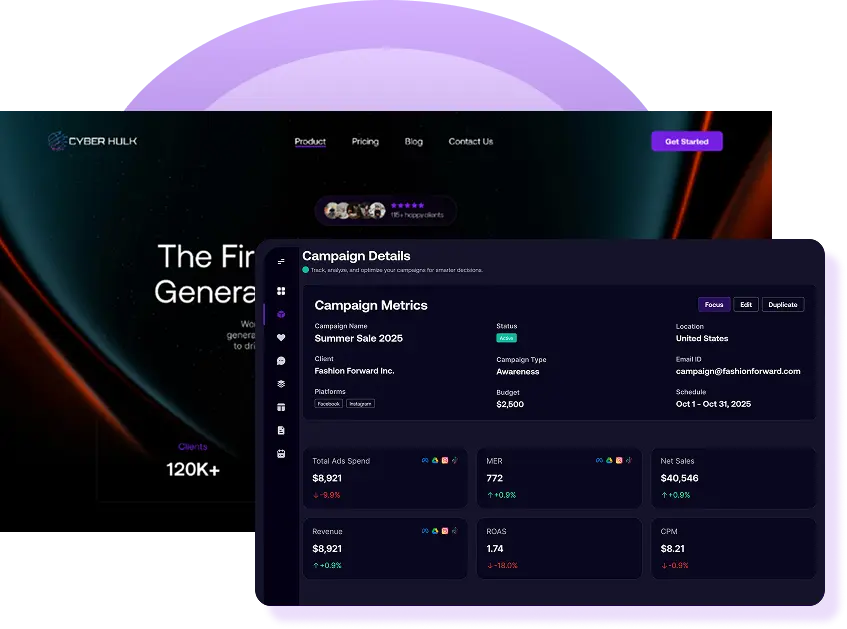
CyberHulk

Generative AI-powered Digital Marketing Platform

SoluLab developed CyberHulk, an AI-powered unified marketing platform that empowers users to create, automate, and monitor digital campaigns. With real-time analytics, workflow automation, and multi-channel integration, it streamlines operations and enhances marketing efficiency. Results achieved are:

  • 70% Faster Campaign Execution
  • 3x Growth In Website Traffic
  • 50% Reduction In Manual Tasks
Read More
Cyberhulk
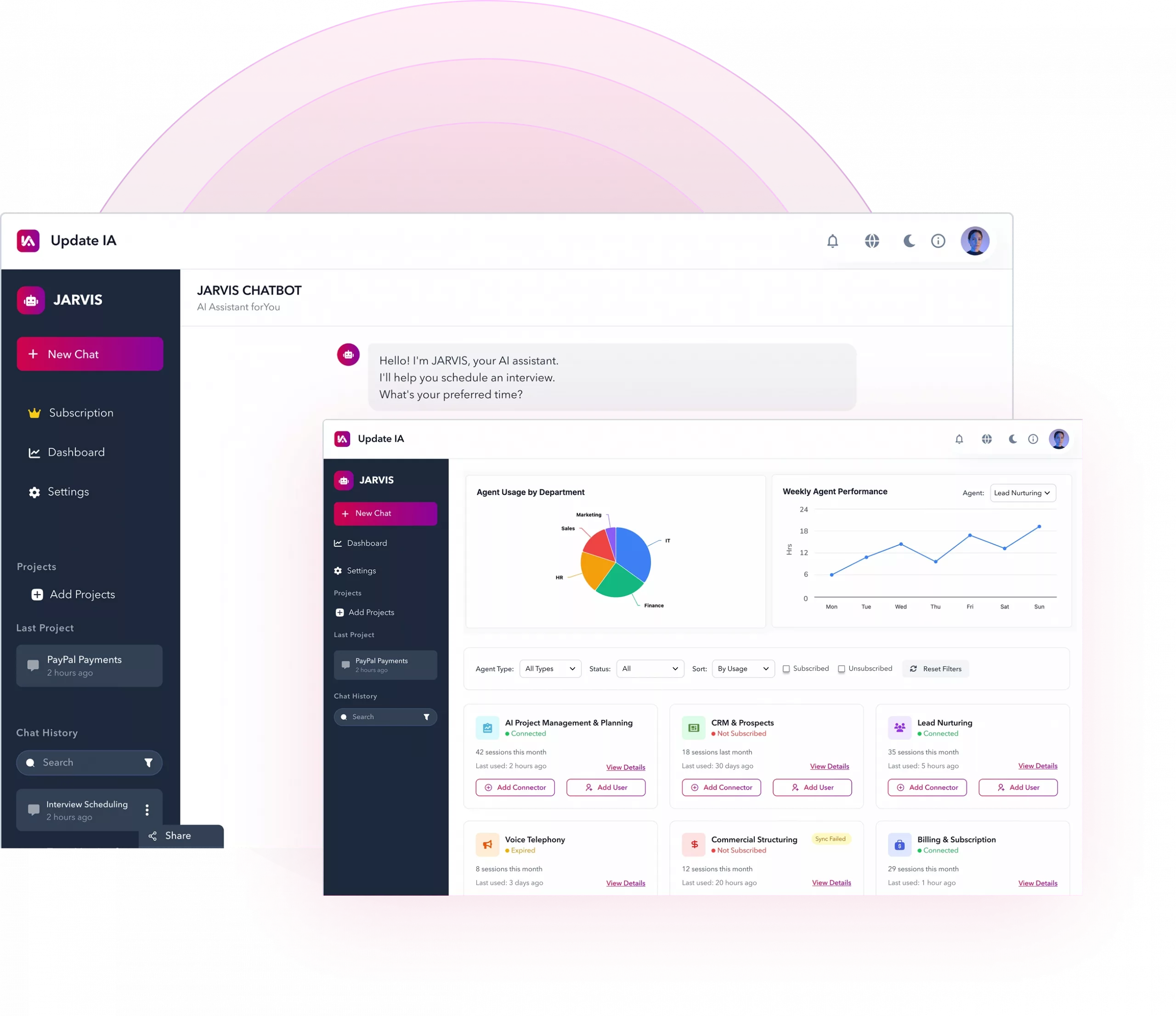
UpdateIA

Gen AI Powered Agentic AI Platform

UpdateIA is an enterprise-grade Generative AI ecosystem built by SoluLab to unify and automate business operations through 14+ specialized AI agents. Powered by a central “Jarvis” brain, it enhances HR, CRM, finance, and support functions. Results achieved are:

  • 80% Reduction In Manual Workflows
  • 40% Integrated Enterprise Connectors
  • 3x Faster Task Execution
Read More
UpdateIA
Testimonials

What our clients have to say for us

SoluLab successfully delivered the project on time, we were very pleased with the team's flexibility and honesty. The team was also highly considerate of our needs. They were very considerate for few minor changes that went outside of the scope (which they gave us complimentary without extra fee). They delivered everything on time.

Greg Edwards

Greg Edwards

Founder, Edamama

The attention to detail and the ability to customize the solution to fit our specific goals was outstanding. Throughout the process, SoluLab’s team was always available, offering insightful advice and ensuring the project stayed on course. The end result has exceeded our expectations, significantly enhancing our operational efficiency and security. What truly stood out was their dedication to building a long-term partnership, making them a key player in our company’s growth.

Sara Routhier

Sara Routhier

Employer Outreach, Quote.com

SoluLab immersed themselves in understanding our goals and challenges, providing innovative, tailored strategies that made an immediate impact. Their expertise, proactive communication, and unwavering support set them apart, making the entire process smooth and efficient. we’ve experienced measurable growth, improved efficiency, and a renewed sense of confidence in reaching our objectives. Working with SoluLab has been a game-changing experience, and we’re excited for what the future holds in this incredible partnership.

Kate Jeffrey

Kate Jeffrey

Marketing & Communications Leader, Greater Houston Healthconnect

SoluLab actually understood our bonding process before touching any code. The vision system now catches seam defects our team used to miss, and we've already avoided a bad batch thanks to its AI-powered predictive maintenance alerts. Exactly the kind of partner we needed to scale.

Anshuman Dash

Anshuman Dash

VP of Operations, Sakho Group

FAQ

Helpful resource to grow your business

Start by defining the business problem and the data you have. Then choose an engagement model (full-time, part-time, or hourly), shortlist candidates with shipped AI projects, and run a technical interview and a short trial. With SoluLab, you get pre-vetted profiles, interview the shortlist yourself, and onboard in 1 day to 2 weeks.

Work with a partner that gives you direct access to each developer, a daily overlap window with your team, and code in your own repositories and cloud accounts. Require weekly demos, code reviews, and a signed NDA and IP assignment before work starts. SoluLab's offshore developers report daily or weekly inside your tools.

Start small. Scope one use case that proves value, such as an MVP chatbot or a single prediction model, and hire one AI developer part-time or hourly instead of a full team. Use the first weeks as a trial to check code quality and communication. Move to full-time once the model works on real data with real users.

Ask them to walk through an AI project they shipped: the data problem, why they chose that model, how they measured accuracy, and what broke in production. Then ask how they'd approach your use case, handle messy or limited data, and monitor the model after launch. Specific answers matter more than framework name-dropping.

Look for Python fluency, a computer science foundation, and hands-on machine learning experience. Deep learning work needs TensorFlow or PyTorch, and LLM projects need prompt engineering and RAG skills. Just as important: building data pipelines for large datasets, deploying with Docker and Kubernetes, and the math to explain why a model behaves the way it does.

You can hire machine learning engineers for predictions and forecasting, computer vision developers for image and video analysis, NLP developers for chatbots and text processing, recommendation system specialists for personalization, and deep learning engineers for complex models. For LLM and generative AI projects, SoluLab also offers dedicated generative AI developers.

SoluLab vets AI developers through technical assessments, coding challenges, and behavioral interviews. We verify each candidate's education and work history and run reference checks. Only engineers with hands-on AI project experience join client work, and you interview the shortlist yourself before anyone starts on your project.

SoluLab's published rate band on Clutch and GoodFirms is $25 to $49 per hour. Your rate depends on seniority, skills, and engagement model. Choose full-time (40 hours a week), part-time (20 hours a week), or hourly, all billed monthly. Share your scope and we'll send a fixed monthly quote before you commit.

Hiring through SoluLab typically takes 1 day to 2 weeks, compared with 4 to 6 weeks for in-house hiring and up to 12 weeks for freelance sourcing. Project work starts on the same timeline, so you can go from a first call to an AI developer working on your roadmap within days.

Yes. Every engagement starts with a signed NDA and an MSA that assigns all work product to you, including code, model weights, and training data. Developers work in your repositories and cloud accounts, or in access-controlled SoluLab environments. SoluLab holds ISO 9001 and CMMI Level 3 and shares its security addendum on request before signing.

Not in the foreseeable future. AI tools now write and review code, but people still have to check the output. In the 2025 Stack Overflow Developer Survey, 46% of developers said they distrust AI accuracy and only 33% trust it. What's changing is the role: companies need developers who can build, test, and deploy AI systems.

Fast. In the 2025 Stack Overflow Developer Survey of 49,000+ developers, 84% said they use or plan to use AI tools in their development process, up from 76% in 2024. Among professional developers, 51% use AI tools daily. Trust hasn't kept pace, so teams still need engineers who can verify AI output.

Articles

Latest Insights from Experts

Top 15 AI Business Ideas to Start in 2026
Artificial Intelligence

Top 15 AI Business Ideas to Start in 2026

Explore 15 AI business ideas to start in 2026, from AI SaaS and automation to content, customer support, and industry-specific AI solutions.