Blockchain brought transparency, decentralization and immutability into business, and it shook up a lot of old corporate habits along the way. Building your own chain from zero, though? That’s slow, fiddly work. Substrate exists to cut that pain down. It’s a framework for putting together custom blockchain networks without writing every layer yourself. Below, we walk through what Substrate is, where it gets used, what it does well, how development actually runs, and a few projects already built on it.
What is Substrate?
Think of Substrate as a toolkit for people who want a blockchain shaped around their own rules. You can start a chain from the ground up. Or you can take existing pieces and bend them toward one narrow purpose. Either way, you aren’t stuck with somebody else’s design decisions, and that freedom is what makes long-lived projects possible.
A chain built on Substrate gets most of its infrastructure for free. Substrate sits in the backend, quietly doing the heavy lifting for teams shipping dApps, cryptocurrencies and other blockchain products every day. The real draw is independence. Developers pick and wire up their own consensus process, their own governance model, their own token economics, and nobody outside the project gets a veto.
It launched in 2019. Adoption since then has been fast. More than 200 blockchain applications, Polkadot, Kusama and Acala among them, run on Substrate. Polkadot alone, itself a Substrate build, carried a market valuation of roughly $60 billion as of February 2023 [SOURCE NEEDED]. Numbers like that tell you where money and developer interest are heading.
Features Of Substrate Blockchain Framework
So what do you actually get? Here are the core features of substrate blockchain framework:
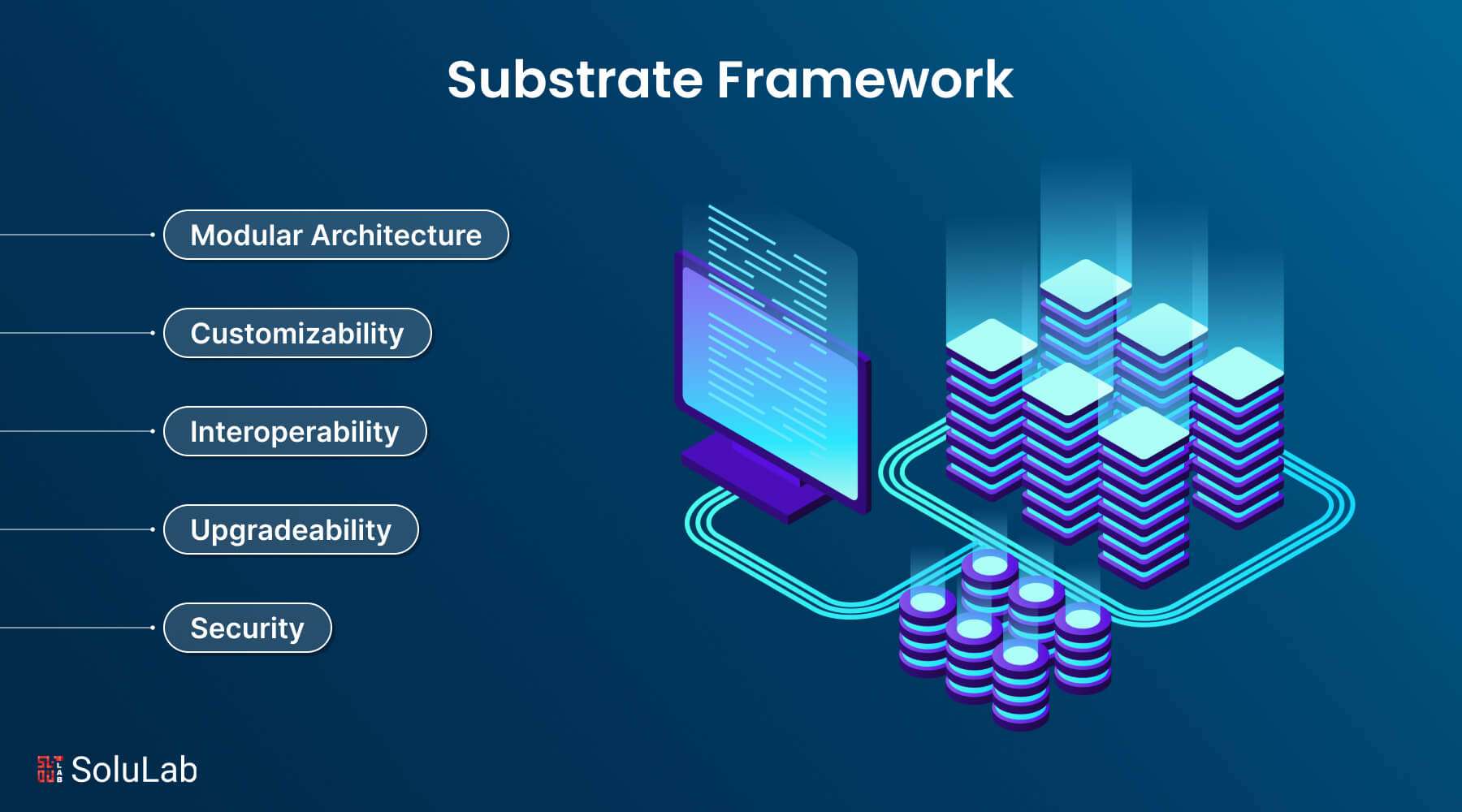
- Modular Architecture: Substrate is built from parts. Picture building blocks: snap one in, pull another out, and the rest of the system doesn’t fall over. That makes the whole thing steadier, and it makes day-to-day development a lot less painful.
- Customizability: Open the box and there are options everywhere. Developers tinker, test, and adjust until the protocol fits. Governance rules, token economics, consensus algorithm: all of it is yours to choose. The payoff is a chain that does the job you built it for, not a generic one you have to work around.
- Interoperability: Substrate chains can talk to other chains. Those cross-chain channels open a route for moving assets between networks. And once chains can do that, the whole space starts to behave less like a set of islands.
- Upgradeability: This one matters a lot. Blockchains have to change over time to stay secure and keep running without errors, and Substrate lets you roll out new protocol versions without drama. That’s what keeps a network useful for years. It also stops it from quietly going stale.
- Security: Security gets serious attention here. Substrate ships with defenses against the common weaknesses and attacks that trip up chains. Strong cryptography plus careful coding practices give Substrate networks a safe base to build on.
Use Cases of Substrate Framework
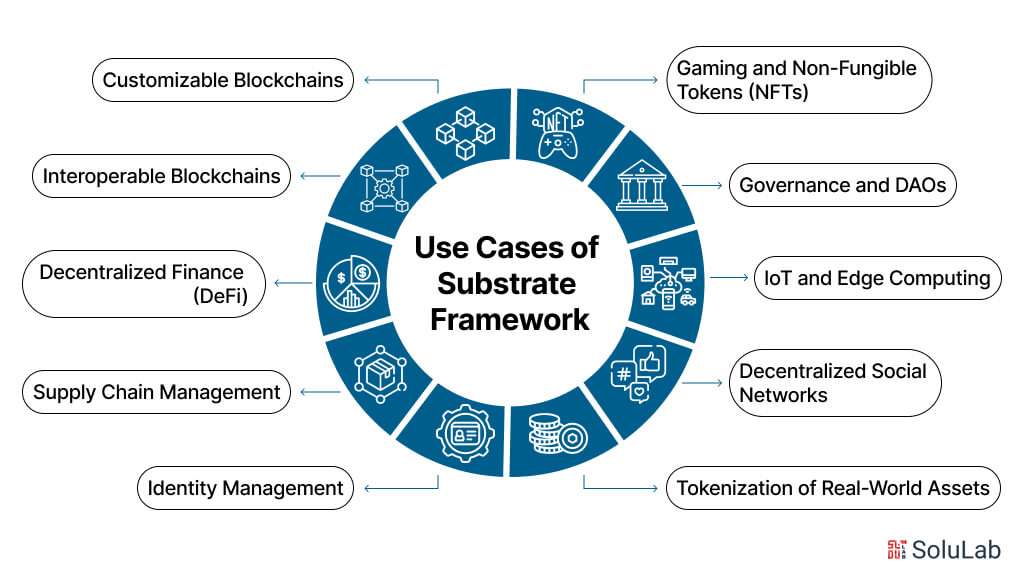
Because it’s modular and flexible, Substrate shows up in a surprising number of industries. Teams use it to build chains that fit one specific problem instead of forcing that problem onto a general-purpose network. Here are the main substrate blockchain use cases we see across different domains:
1. Customizable Blockchains: This is the obvious one. You can build a chain around a single job, whether that’s supply chain management, decentralized finance (DeFi), identity verification, gaming or something else entirely. Every industry has its own quirks. Substrate lets the chain match them.
2. Interoperable Blockchains: Chains built with Substrate can exchange data with one another. That’s handy anywhere several networks need to cooperate: cross-chain asset transfers, decentralized exchanges (DEXs), or apps that span more than one chain.
3. Decentralized Finance (DeFi): DeFi is a natural fit. Decentralized exchanges, lending platforms, stablecoins, asset management tools, you name it. Because the architecture is modular, developers can build small financial primitives that plug into each other, then stack them into more complex products and services.
Related: Defi- The Influensive Trend in Blockchain- A Complete Guide
4. Supply Chain Management: Put every step of a supply chain on a blockchain and something useful happens. Anyone involved can check where a product came from and whether it’s genuine. Counterfeiting gets harder. Transparency goes up. Logistics get simpler, too.
5. Identity Management: Here the user holds the keys. Substrate can run decentralized identity systems where people own their personal data and share only the pieces they choose, with parties they trust. Self-sovereign identity, KYC/AML compliance, access management and secure authentication all benefit.
6. Gaming and Non-Fungible Tokens (NFTs):Games and marketplaces for non-fungible tokens (NFTs) are another common build. Developers mint one-of-a-kind digital assets (in-game items, collectibles, artwork) and let players buy, sell and trade them safely on-chain.
7. Governance and DAOs: Substrate comes with tools for setting up decentralized autonomous organizations (DAOs) and running governance on-chain. In practice, that means a community can steer its own network. Members vote together on protocol upgrades, on where funding goes, and on the other decisions that keep a project alive, all out in the open.
8. IoT and Edge Computing: Picture devices that deal with each other directly, no central middleman. Substrate can support decentralized IoT (Internet of Things) networks like that. Pair blockchain with edge computing and you get IoT setups that are secure and can scale, useful for smart cities, supply chain monitoring, environmental sensing and plenty more.
9. Decentralized Social Networks: What if users actually owned their social data? Substrate can power networks where they do. People connect, post, and earn from what they contribute, without a central company sitting in the middle. Thanks to the modular design, teams can bolt on content moderation, reputation systems, micro-payments and privacy tools. The result is a social platform that’s lively and hard to censor.
10. Tokenization of Real-World Assets: Real estate, stocks, commodities, intellectual property. Substrate can turn any of these into tokens on a blockchain. Once an asset is a token, you can transfer it easily, split it into fractions, and trade it openly and cheaply. With Substrate’s smart contract and interoperability features, developers can build tokenization platforms that stay within regulatory rules, add liquidity, and open fresh investment options across many asset types.
The Substrate Blockchain Development Process
First things first: most developers start by learning Rust, the language Substrate is written in, and getting their machine set up. After that, the work usually follows these steps.
- Setting Up the Development Environment: Step one is Rust and a working environment. Here Substrate has a real edge over Ethereum, because setup is simple. Less time fighting tooling means more time building.
- Project Launch: Next, developers use the Substrate command-line interface (CLI) to kick off a new project. It lays down the basic structure and config files the blockchain development process needs.
- Customization: Now the project gets shaped to fit. Developers choose the consensus process, the token economics, the governance structure and more. Because the architecture is modular, pulling in third-party modules and features is straightforward, and the interface doesn’t fight you.
- Runtime Development: This is the heart of the job. Developers write the runtime logic in Rust, and that code sets the rules of the chain: how transactions get processed, how state changes, how smart contracts run. Get this part wrong and nothing else matters.
- Testing and Debugging: Substrate has its own built-in testing framework, and teams lean on it hard. Unit tests, integration tests, stress tests. The point is to keep the chain valid and dependable, which is what earns trust from investors and users in how the chain behaves.
- Deployment: Once it passes all that checking, the Substrate chain goes out to a testnet or a chosen client first. When functionality and performance are where they should be, developers push it to a public network for production use.
Practical Applications of the Substrate Framework
Theory is fine. Real projects are more convincing. Substrate’s modular design, flexibility and ease of development have already made it the base for a number of live networks:
- Polkadot (DOT): Polkadot is the showcase. It runs as a multi-chain protocol, and its standout strength is connecting chains to each other. With Substrate underneath, Polkadot acts as the foundation that lets assets and data move freely across many chains, which gives a varied, growing network room to multiply.
- Kusama (KSM): People call Kusama Polkadot’s “canary network.” New features and upgrades land here first, live, before they reach Polkadot. That experimental streak pulls in tinkerers and reformers who test and refine Substrate-based ideas in the wild. Iteration is quick. The limits of what Substrate can do keep getting pushed.
- Chainlink (LINK): Chainlink uses the Substrate framework to deliver dependable oracle responses to smart contracts [SOURCE NEEDED]. By drawing on the modular architecture, it can offer custom-built oracles that slot into different chain structures and meet varied demands, which makes it more adaptable than rigid oracle setups.
- Moonbeam: Moonbeam shows off just how flexible Substrate is: it’s an Ethereum-compatible smart contract platform. Built largely on Substrate, it gives developers a familiar Ethereum-style environment. Deploying smart contracts is easy. And they get better scalability and performance from the Substrate tech underneath.
- Acala Network: Acala is a DeFi platform that uses Substrate’s modular framework to offer a spread of financial services: stable currency, liquidity and decentralized lending. With Substrate at its core, it delivers DeFi protocols that are easy to use, safe and efficient.
- Litentry: Litentry is a decentralized identity aggregation system built on the Substrate framework, aimed at giving people more say over their own digital identity. It uses Substrate to build an identity product where users fully control their data and move between different platforms and apps at whatever privacy level they want.
Benefits of Substrate Framework
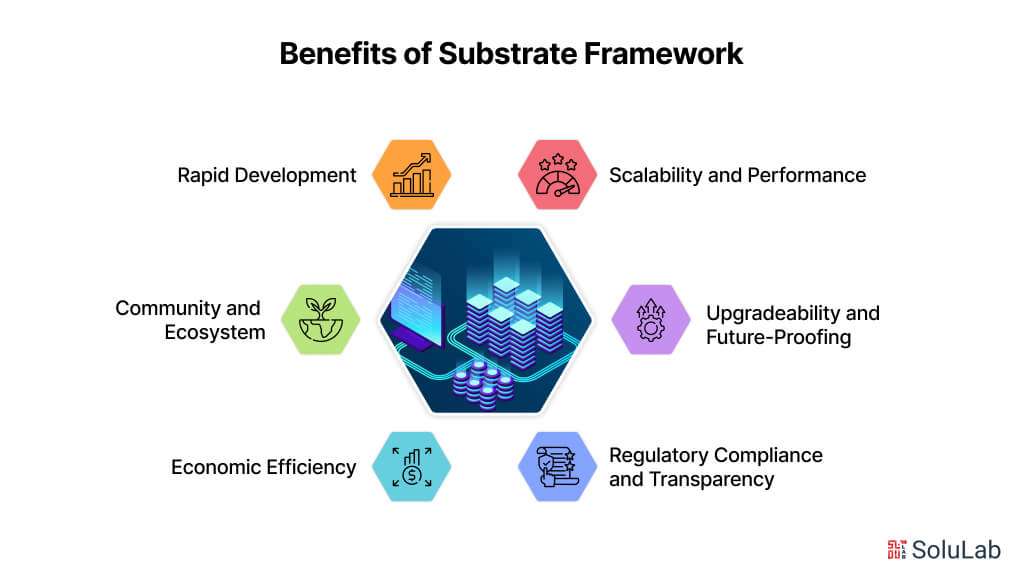
Why do developers and blockchain fans keep picking Substrate? A few reasons stand out:
1. Rapid Development: The tooling is friendly. Between the Substrate command-line interface (CLI) and the Substrate Runtime Module Library (SRML), a lot of busywork disappears, and products reach market sooner. Add thorough documentation and a helpful community, and teams can prototype, test and ship quickly.
2. Scalability and Performance: Scale was part of the plan from day one. Substrate uses techniques like sharding and parallel execution to raise throughput. That lets developers build fast applications that cope with heavy transaction volume and a user base that keeps growing.
3. Community and Ecosystem: There’s a busy, active crowd around Substrate: developers, contributors and enthusiasts who keep improving and extending it. The growing pile of Substrate-based projects, tools and services hands new builders plenty of resources and people to work with. That speeds up new ideas across the whole blockchain space.
4. Upgradeability and Future-Proofing: Upgrades happen on-chain. Substrate has built-in ways to change runtime modules and roll out upgrades without hard forks or network downtime. So an app built on it can keep up with new requirements, new tech and community feedback, and stay useful for the long haul.
5. Economic Efficiency: Running a node costs less. Substrate’s modular, lightweight design needs fewer resources than many other blockchain frameworks. Cheaper nodes mean a lower bar for developers and validators to get involved, which widens access to blockchain and brings more people into the network.
6. Regulatory Compliance and Transparency: Regulated industries need a paper trail. Substrate supports compliance features like identity verification, transaction monitoring and auditability, so projects can meet legal and regulatory requirements. That transparency builds trust with users, investors and regulators alike, and it makes blockchain an easier sell in regulated industries and jurisdictions.

Concluding Thoughts
Substrate is a milestone in blockchain development, and any firm building blockchain solutions would be making a mistake to ignore it. It gives programmers a wide set of options for safe, adaptable, scalable applications. What sets it apart is simple: you can build a chain shaped around a real-world problem in a specific industry, rather than squeezing the problem into someone else’s chain. Firms that adopt Substrate, get good at it, and keep sharpening their builds are the ones who will turn blockchain’s promise into working systems. And that points toward a future where people, not gatekeepers, steer how technology moves forward.
As a blockchain development company, SoluLab puts its Substrate expertise to work helping businesses get their blockchain plans off the ground. Our developers know Rust and Substrate well, and we build end-to-end solutions around each client’s actual requirements. Concept, design, development, deployment, maintenance: we stay with you at every stage and make sure the new system fits cleanly with what you already run. Need a custom blockchain app, an interoperable network, or a decentralized finance (DeFi) platform? SoluLab brings technical depth and industry know-how to build something that scales. Get in touch today and let’s talk about what blockchain can do for your business.
FAQs
Shipra Garg is a tech-focused content strategist and copywriter specializing in Web3, blockchain, and artificial intelligence. She has worked with startups and enterprise teams to craft high-conversion content that bridges deep tech with business impact. Her work translates complex innovations into clear, credible, and engaging narratives that drive growth and build trust in emerging tech markets.