Pick up almost any gadget in your home today and there’s a decent chance AI is quietly running underneath it. That shift touches everything from chores to health tracking. Amazon’s Alexa is the obvious example: say a sentence, and lights turn on, music starts, a timer counts down. No app, no remote, no menu digging.
Wearables take that same idea outside the house. A watch on your wrist tracks steps, sleep, heart rate, and turns raw numbers into something you can actually act on. That’s the real shift: health tracking used to mean a doctor’s visit and a chart. Now it’s ambient, running in the background while you live your life. According to Gitnux, AI-driven consumer electronics is on pace to hit $37.2 billion by 2027, growing at roughly 14.2% a year from 2020 onward.
AI in consumer electronics isn’t a gimmick tacked onto a spec sheet. It changes how you actually use the thing day to day. And as the technology keeps maturing, that gap between “smart” and “actually useful” keeps closing.
This blog breaks down artificial intelligence (AI) in consumer electronics: what it does, where it helps, and what it changes for the people using it. Let’s get into it.
What is Consumer Electronics?
Consumer electronics, sometimes called consumer tech, means electronic products built for personal or household use rather than industrial or commercial settings. They exist to make ordinary tasks faster, simpler, or more enjoyable. That covers a huge range: a basic alarm clock sits at one end, a laptop or gaming console at the other.
What ties them together is context: they’re built for personal or home use, shaped around specific things people actually want or need. A few common categories:
- Audio Devices: Headphones, speakers, MP3 players, and music streaming devices
- Computing Devices: Desktop computers, laptops, tablets, and smartphones
- Gaming Devices: Consoles, handsets, and accessories
- Imaging Devices: Cameras, camcorders, and scanners
- Entertainment Devices: Televisions, DVD players, and streaming devices
- Communication Devices: Phones, modems, and routers
- Home Appliances: Refrigerators, air conditioners, washing machines, and microwaves
These devices aren’t optional anymore for most people. They’re how you stay in touch, find information, watch a show, or just get through the day. What pushes the category forward is a mix of better hardware, shifting tastes, and companies chasing problems nobody had solved yet.

Features of AI in Consumer Electronics
AI has quietly stacked a lot of new capability onto everyday devices. Here’s what actually shows up in features of AI in consumer electronics:
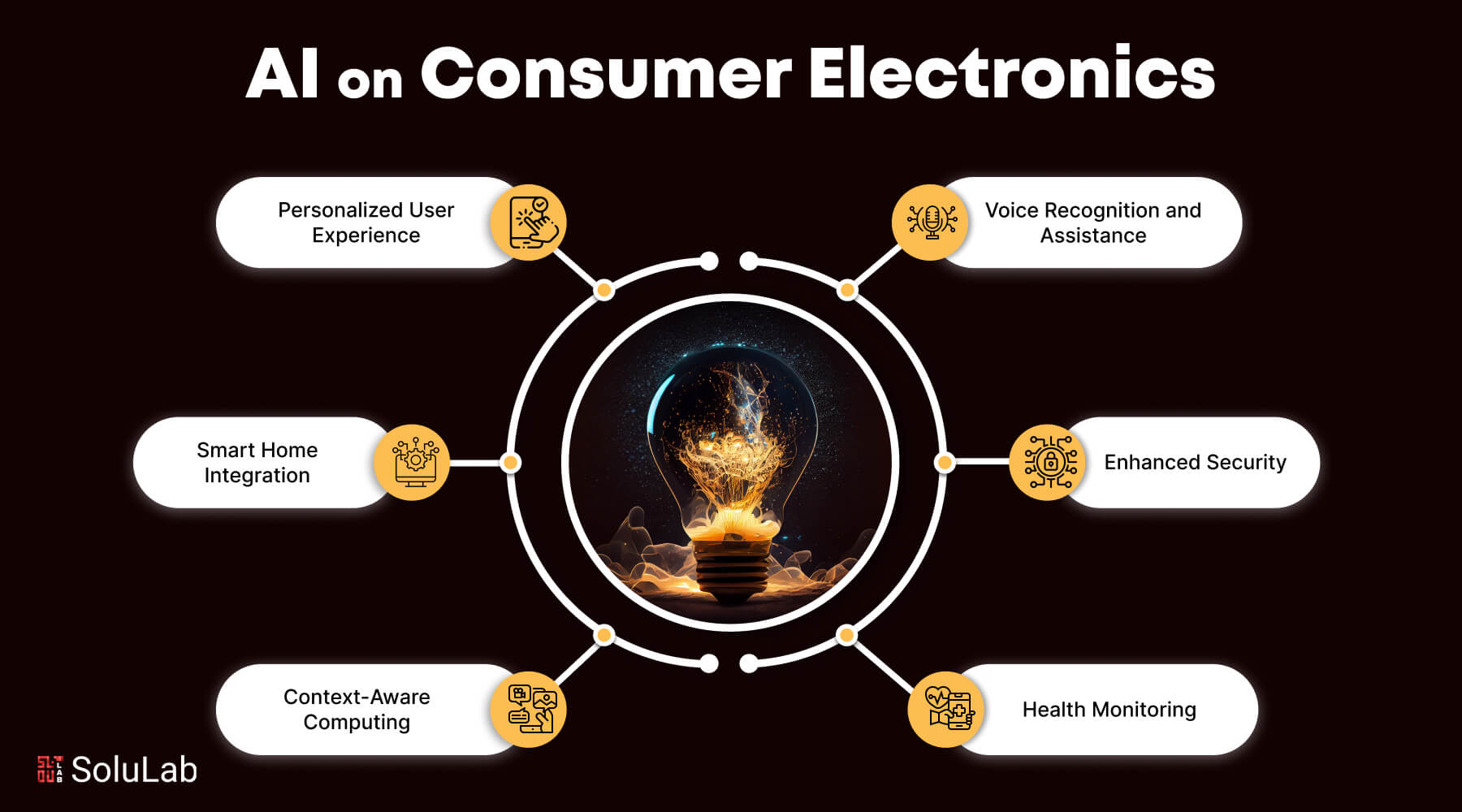
1. Personalized User Experience: Algorithms watch how you use a device and quietly adjust. A smart TV starts suggesting shows that fit your taste. A phone rearranges itself around your habits without you asking it to.
2. Voice Recognition and Assistance: Voice-controlled virtual assistants like Amazon’s Alexa, Google Assistant, and Apple’s Siri are now baked into most consumer gadgets by default. You talk, they act: controlling devices, pulling up information, or checking things off a list.
3. Smart Home Integration: AI ties separate smart home devices into one working system. Thermostat, lights, cameras, locks. Instead of juggling five apps, you get one coordinated setup that adjusts on its own.
4. Enhanced Security: Face recognition, biometric checks, and anomaly detection all lean on AI now. That’s a real upgrade for phones, laptops, and home systems trying to keep out anyone who shouldn’t be there.
5. Context-Aware Computing: Devices increasingly read the situation around them, not just direct commands. A smart camera picks out a specific object or person. A sound system adjusts its output because it can tell the room changed.
6. Health Monitoring: Wearables track heart rate, sleep, and activity around the clock. The value isn’t the raw data, it’s the alerts and patterns that come out of it, which help people actually catch problems early.
AI Technologies in Consumer Electronics
A handful of underlying technologies show up again and again in consumer electronics:
1. Machine Learning (ML): machine learning (ML) powers image recognition, natural language processing, and predictive analytics inside consumer devices. The point of ML here is simple: the device gets better at its job the more data it sees, without an engineer rewriting the code each time.
2. Natural Language Processing (NLP): NLP is what lets a device understand plain human language instead of rigid commands, which is why chatbots, voice assistants, and smart speakers work at all. Voice commands, sentiment reading, translation. It all runs through NLP under the hood.
3. Computer Vision: Computer vision lets a system make sense of images and video the way a person would glance at a scene. Object identification, scene interpretation, facial recognition. All of it comes from the same underlying approach.
4. Speech Recognition: Speech recognition turns spoken words into text so a device can respond to your voice instead of a button press. Car entertainment systems, smart speakers, phones all depend on it to catch and process what you say.
5. Reinforcement Learning: reinforcement learning works through trial and error: a machine tries something, sees what happens, adjusts. That’s exactly how a robotic vacuum learns to navigate a room, or a drone learns to complete a task without crashing into things.
6. GANs: Generative Adversarial Networks, GANs for short, are a deep learning technique built to generate new data, images, or content from scratch. In consumer devices, that shows up as style transfer, content creation, and image synthesis.
Influence of AI Technologies in Consumer Electronics
AI hasn’t just added features to consumer electronics. It’s changed how devices operate, how they respond to you, and how they fit into daily routines.
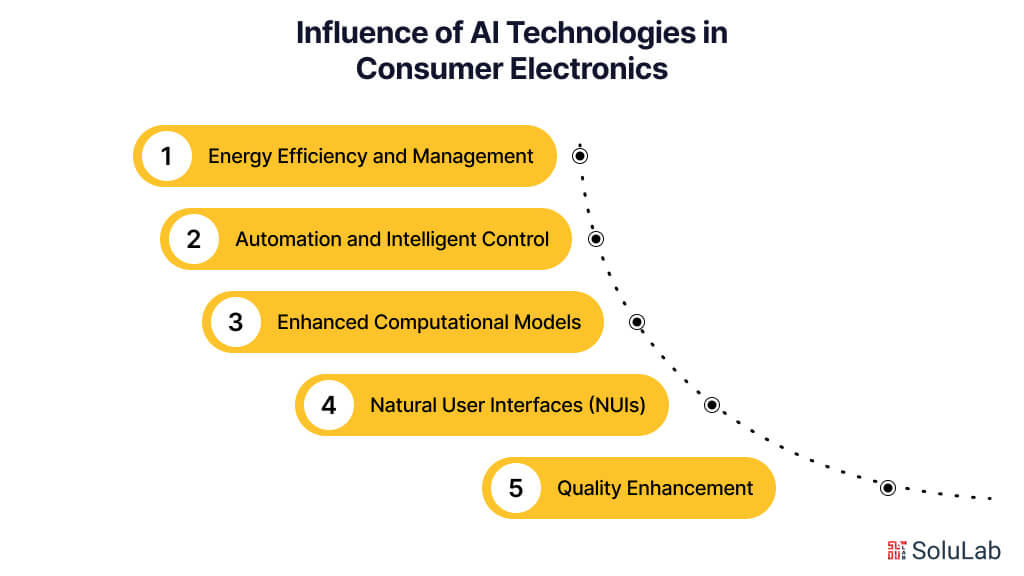
- Enhanced Computational Models
AI pushes the computational limits of consumer devices by layering in algorithms that learn from data instead of following fixed rules. Some are simple, predicting what you’ll want on a home screen. Others are heavy neural networks doing image or speech recognition. Machine learning, deep learning, reinforcement learning: these are the building blocks that let a device chew through huge amounts of information quickly.
- Automation and Intelligent Control
Tasks that used to require a person now run on their own. A smart thermostat is the clearest example: it watches your habits over time and starts adjusting the temperature before you even think to. That’s sensor data getting processed and turned into a real-time decision, and it’s a good example of AI workflow automation.
- Natural User Interfaces (NUIs)
Natural language processing and computer vision have changed what “using a device” even means. Talk to it, gesture at it, and it responds. Devices with NUI capabilities understand voice commands, hand movements, and visual cues without forcing you to learn a menu structure first. That lowers the barrier for anyone who isn’t naturally tech-savvy, and it makes the whole interaction feel less like operating a machine.
- Energy Efficiency and Management
AI-driven optimization looks at usage patterns, environmental conditions, and behavior, then adjusts power settings on the fly to cut waste without hurting performance. That means lower energy bills for the person using the device and a smaller environmental footprint overall, while the device itself keeps running well for longer.
- Quality Enhancement
Cameras and displays have gotten noticeably better because of AI image processing, not just better hardware. Trained models sharpen contrast, correct color, add sharpness, and improve noise reduction. The result: media that looks more polished, and more room for people to get creative with what they shoot or watch.
What Changes Is AI Bringing About in the Consumer Electronics Sector?
AI is reshaping individual product categories in different ways. Here’s how it plays out device by device:
- Smartphones: Edge computing lets phones process huge volumes of raw data right on the device, with AI helps smartphones handling it locally instead of shipping everything to the cloud. That means faster decisions and quicker responses, since the phone doesn’t have to wait on a round trip to a server. Machine learning also lets a handset build a profile of your habits over time, tailoring itself to how you actually use it.
- Smart Refrigerators: Newer models don’t just keep food cold, they watch what’s inside using object recognition. That lets them build shopping lists, track what’s running low, and text you a heads-up before you’re out of milk. Pair that with a voice assistant, and you can check the fridge’s inventory without opening the door.
- Smart Ovens: Built-in cameras and machine learning let these ovens recognize what food is inside and suggest a recipe based on it. They adjust temperature and timing to match what you’re cooking, and over time they learn your preferences well enough to need less and less input from you.
- Smart Washing Machines: AI tunes energy use, fabric care, and cycle efficiency together instead of treating them separately. These machines estimate cycle times, adjust wash settings, and tell fabrics apart automatically. Some restock detergent on their own, flag maintenance issues before they become expensive, and let you control a cycle from your phone.
- Smart TVs: Voice navigation, personalized recommendations, and sharper picture processing all come standard now. Watching history feeds directly into what shows up next, and voice assistants like Google Assistant and Amazon Alexa mean you barely need the remote.
- Smart Speakers: Google Home and Amazon Echo run on AI to handle voice commands, stream music, and control a smart home setup. They answer questions, understand plain language, and link up with other smart devices to automate routines.
- Smartwatches: AI-enhanced smartwatches track fitness and health metrics, then turn that data into coaching you can actually act on. Machine learning spots patterns in your activity, flags anything unusual, and offers practical suggestions rather than just a wall of numbers.
- Security Systems with Smart Cameras: Smart security cameras can now tell different kinds of activity apart and react in real time instead of just recording footage. Trained to recognize specific events and monitor physical objects, they add a real layer of protection beyond a static video feed.
The payoff from AI in consumer electronics spans security, personalization, efficiency, and plain new functionality. These customer service automation advances are changing what people expect from their gadgets: smarter, easier to use, and more responsive to what you actually need.
AI Applications in Consumer Electronics
AI has worked its way into nearly every corner of consumer electronics, changing how devices behave and what they’re capable of.
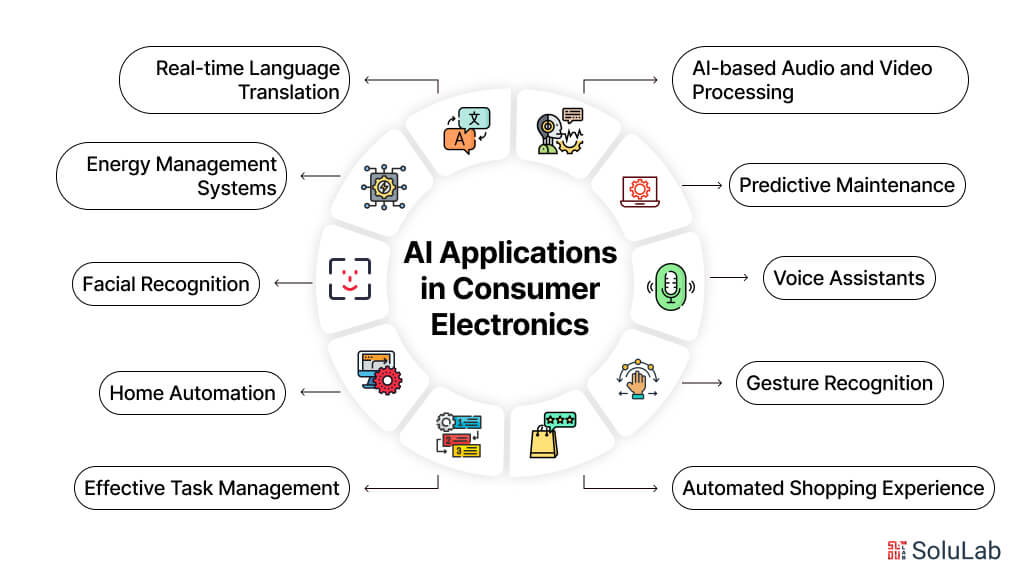
1. Voice Assistants: Amazon Alexa, Apple Siri, and Google Assistant are now a normal part of owning a device, not a novelty. Every interaction teaches them a bit more about handling commands and questions correctly. AI-powered consumer electronics assistants use NLP to catch complex phrasing, different languages, and accents, so the exchange feels natural instead of stilted. Hands-free control means you can run speakers, phones, and home automation systems without touching anything.
2. Facial Recognition: AI has sharpened object identification, scene understanding, and facial recognition across consumer devices. Phones use facial recognition for quick, secure biometric login, so you get in fast without typing a passcode. AI also sorts photos by the faces it recognizes, which makes finding an old picture painless. On the security side, AI-enabled cameras spot and identify people more reliably, tightening monitoring without giving up privacy at home. Risks get flagged faster, which matters when it’s your property on the line.
3. Predictive Maintenance: AI systems watch how well equipment is running and catch trouble before it turns into a breakdown. By tracking temperature, pressure, and energy use over time, these algorithms notice anomalies that hint at a future failure. Catching it early means a repair or a tune-up happens on your schedule, not after the device dies. That stretches the device’s lifespan, cuts downtime, and keeps maintenance costs from piling up.
4. Gesture Recognition: AI-based gesture recognition lets you control a device with a hand movement instead of a remote or a touchscreen. Wearables, game consoles, smart TVs. All of them can use this. Wave your hand, and you navigate a menu, control playback, or trigger a command, no physical input device required. That’s especially useful when typing or reaching for a remote isn’t practical. It also makes interactions feel more natural, particularly in gaming and entertainment, where waving at the screen just feels right.
5. Home Automation: Home automation, an AI electronic system, has turned ordinary homes into something closer to a coordinated living space. Lighting, temperature, and security devices talk to each other instead of operating in isolation, which makes the whole home noticeably more efficient and comfortable. These AI-powered systems manage appliances and security together, building an environment that adjusts to what you actually need. The result: a home that anticipates your routine instead of waiting for you to set it manually.
6. AI-based Audio and Video Processing: AI is rewriting how audio and video processing works in consumer electronics. Algorithms cut background noise, sharpen voice clarity, and improve overall sound quality, producing audio that sounds noticeably more realistic. Noise cancellation powered by AI and ML strips out unwanted interference so audio comes through cleanly. On the video side, AI and ML models trained on both high- and low-resolution frames can generate sharp frames even from lower-quality input. These super-resolution techniques make a real difference in how crisp and watchable the final picture looks.
7. Energy Management Systems: AI plays a direct role in cutting building energy use through smarter management systems. These systems read sensor and smart meter data, then adjust lighting, heating, and cooling in real time to squeeze out waste. Because AI keeps tracking and adapting as conditions change, energy use stays matched to actual occupancy instead of running on a fixed schedule. That adds up to real cost savings and a smaller environmental footprint. With AI in consumer electronics handling the heavy lifting, people get more comfort and more control over building genuinely sustainable living spaces.
8. Real-time Language Translation: AI lets consumer devices translate speech in real time, cutting through language barriers that would otherwise stop a conversation cold. AI-enabled earphones, for instance, can translate a live conversation between two people speaking different languages as it happens.
9. Effective Task Management: AI-capable devices help people manage their day more efficiently. An AI-connected smart home hub can build and edit to-do lists, set reminders, and book appointments just from voice commands and calendar events. Routine chores get handled without manual input, which frees up time and keeps things from slipping through the cracks.
10. Automated Shopping Experience: AI-powered devices can now handle shopping tasks on their own. A smart refrigerator, for example, tracks what food is on hand, suggests recipes based on it, and places a grocery order automatically once supplies run low. Tying that into an online shopping platform makes meal planning and restocking far less of a chore.
Related: Generative AI in Automotive Industry
Benefits of AI in Consumer Electronics
Bringing AI into electronics pays off in a few concrete ways:
- Better User Experience: AI in electronics learns what you like and how you use a device, which makes interactions feel personal instead of generic. Devices end up easier, and honestly more fun, to use.
- Greater Efficiency: AI automates repetitive tasks and tightens up processes, so devices run faster and burn less power. That saves both time and resources.
- More Automation: AI-driven automation cuts down on manual input, letting devices handle tasks by themselves. That frees up your time and takes the mundane chores off your plate.
- Improved Communication: AI can transcribe voicemails into text, translate messages, and sort notifications by what actually matters, so staying connected takes less effort.
- Advanced Features: AI lets gadgets do things that simply weren’t possible before: voice recognition, image processing, understanding natural language, making predictions. All of it adds real functionality.
- Optimized Performance: AI reads data in real time so devices run at their best, which means better use of resources, fewer failures, and stronger performance overall.
- Cost Savings: Lower energy use and tighter efficiency both translate to real savings. Manufacturers benefit too, cutting production costs and simplifying operations.
- Valuable Data Insights: AI processes huge volumes of device data to surface patterns in user behavior, which feeds directly into better product decisions down the line.
- Future-Ready: Software updates let AI-driven devices keep adapting instead of going stale, which keeps them relevant well past their first year on the market.
Put it all together, and AI in consumer electronics makes devices smarter and more capable, and that’s what’s pushing the whole industry forward.

Concluding Remarks
AI hasn’t just tweaked consumer electronics at the edges. It’s made interactions with technology feel more intuitive, more efficient, and genuinely personal. Devices now learn from how you use them, run more efficiently, and handle routine tasks without being asked twice. Smart home systems that get ahead of your needs, communication tools that cut out friction. This is what AI-powered electronics actually look like day to day. And as the technology keeps advancing, expect more capability to show up in the products people already own.
That said, putting AI into consumer electronics isn’t free of friction. Data privacy, strong security, and the sheer difficulty of building reliable AI algorithms all come with the territory. SoluLab, a leading AI development company, works through exactly these challenges, building AI solutions shaped around what consumer electronics actually need. With experience building secure, efficient, and scalable AI systems, SoluLab helps your devices meet, and go beyond, what users expect. To talk through how SoluLab can bring AI into your products, get in touch.
FAQs
Shipra Garg is a tech-focused content strategist and copywriter specializing in Web3, blockchain, and artificial intelligence. She has worked with startups and enterprise teams to craft high-conversion content that bridges deep tech with business impact. Her work translates complex innovations into clear, credible, and engaging narratives that drive growth and build trust in emerging tech markets.