Ask any HR lead what their week looks like and you will hear the same list: paperwork, hiring, onboarding, and the endless work of keeping people engaged. The process side of it creaks. Approvals sit in someone’s inbox, answers differ depending on who you ask, and employees give up waiting. That drag costs the HR team its output, its people, and most of all its time to think strategically.
This is where AI agents earn their keep. They take the repeating work off the desk so HR staff can spend their hours on things that actually need a human brain. And they read data at a scale no team can match, surfacing patterns early enough to act on instead of react to, which is usually what separates a growing company from a stalled one.
| Almost 60% of HR professional departments employed AI in 2024 to help managers give employees more detailed and meaningful feedback. |
So what follows is a practical walk through how HR teams are putting AI agents to work: tightening processes, deciding with better information, and building a workforce that stays sharp and stays put.
What are AI Agents for HR?
Strip away the marketing and an AI agent for HR is software that runs on artificial intelligence and machine learning, pointed at the human resource work nobody enjoys doing twice. Automation handles the repetition. Natural language processing (NLP) handles the questions people type in plain English. Analytics handles the rest. Between them they cover hiring, engagement, performance reviews, and workforce planning.
Agents alone will not fix a broken HR stack, though. Before you buy anything, look at the HR tools sitting underneath: recruitment, employee records, performance management, payroll, compliance, workforce planning. Get those talking to each other and the agents have something worth reading. Skip that step and you have built a clever tool on top of scattered data.
How AI Agents Are Transforming HR Operations?
AI human resources software gets built for a narrow set of jobs inside this function, and that is what people mean by AI agents in HR. Machine learning, natural language processing (NLP), and a handful of other AI techniques do the lifting. Four jobs come up again and again:
Data Gathering and Analysis
Pulling data together is the part HR agents are genuinely good at. Personnel databases, applicant tracking systems, performance numbers, feedback surveys: all of it lands in one place, organized, without someone exporting spreadsheets at 7pm. Then the machine learning models go to work on it. You get forecasts, early warnings, and suggestions you can argue with, which beats a gut call. Habits, preferences, where the mood is shifting in a particular team. HR sees the shape of the workforce instead of guessing at it, and decisions about satisfaction and staffing stop being coin flips.
Automation and Optimization of Processes
Payroll runs. New hire onboarding. Training records. Compliance reporting. All of it is procedural, all of it is automatable, and agents handle the messy edges too, the exceptions and mistakes and odd cases that usually get escalated to a person. The systems sharpen as they run, learning from what they got wrong last cycle. What that buys you is HR capacity: time for workforce transformation, for culture work, for developing the people you already have instead of processing them.
Making and Carrying Out Decisions
Agents also sit in on the hard calls. Budget planning, headcount, performance management, who is ready to step into a role when someone leaves: each of those improves when the reasoning starts from evidence and stays tied to what the business is actually trying to do. The part people underrate is explainability. A good agent shows its work, which means a manager can push back on a recommendation rather than nod at it, and that is how trust gets built inside an HR team.
Working Together and Communicating
Communication is the other half. Agents act as a shared hub for HR teams, other departments, and outside partners, so the policy everyone quotes is the same policy and project status is not trapped in a thread. Global hiring is a good example, where tools like Hire with Columbus help teams weigh options across countries. Conversational agents take the individual side of it: an employee asks a question, gets a straight answer, at whatever hour they asked
Top Use Cases of AI Agents in HR You Should Know
Take away the repetitive chores, speed up the decisions, give employees a reason to stay engaged, and HR operations look different within a couple of quarters. Here are the main AI Agents’ use cases that apply squarely to Human Resource management:
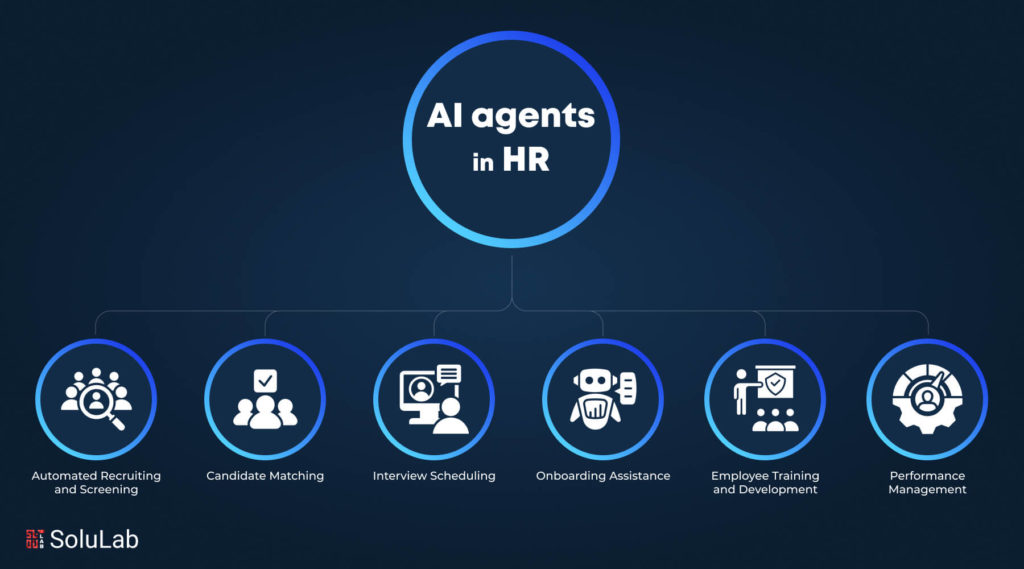
| Use Case | Function | Key Benefit |
| Automated Recruiting | Screens resumes and shortlists candidates. | Faster, unbiased hiring. |
| Candidate Matching | Matches profiles with job requirements. | Better hires, higher retention. |
| Interview Scheduling | Automates interview coordination. | Saves time, reduces admin work. |
| Onboarding Assistance | Guides new hires, answers queries. | Smooth onboarding, higher engagement. |
| Training & Development | Recommends personalized learning. | Supports career growth. |
| Performance Management | Analyzes and improves performance. | Objective feedback, better productivity. |
| Employee Engagement | Conducts surveys, analyzes feedback. | Boosts satisfaction, reduces turnover. |
| Retention Analytics | Predicts attrition risks. | Helps retain top talent. |
| Payroll & Benefits | Automates payroll and benefits processing. | Error-free, timely payments. |
| Compliance Management | Monitors legal and policy compliance. | Reduces legal risks. |
| Employee Self-Service | Enables access to HR services. | Reduces HR workload. |
| Succession Planning | Identifies future leaders. | Ensures leadership continuity. |
Advantages of AI Agents in HR
Put an AI agent for human resources (HR) in place and two things shift at once: what employees experience day to day, and how the company manages its people. These are the AI Agents’ benefits in HR worth knowing:
1. Productivity and Efficiency: Tracking personnel records, booking interviews, sifting resumes. None of that needs a specialist, and agents take it over. The HR team gets its calendar back and spends it on work that moves the business, while the admin pile stops setting the department’s ceiling.
2. Better Decision-making: There is more HR data in most companies than anyone reads. AI systems go through it and come back with predictive analytics and things you can act on, the trends and correlations buried in employee records. Hiring, performance, development, retention: all four get sharper when the conversation starts from what the numbers say.
3. Improved Employee Experience: A human resource AI agent answers the benefits question, the policy question, the training question, the where-does-my-career-go question, and it answers them for that specific person rather than reciting the handbook. People notice when a system treats them individually. Engagement follows.
4. Savings: Agents AI cut what HR costs to run, simply by automating tasks and tightening procedures. Companies using AI in HR report cost savings of up to 25% on HR operations. Most of that comes from manual work disappearing and throughput going up. The compounding part shows up later: fewer errors, cleaner compliance records, processes that stop leaking money quarter after quarter.
5. Scalability and Adaptability: Headcount plans change. Hiring surges, then stops. Seasonal peaks hit the same month every year and still catch people off guard. Agents scale to whatever the workload happens to be, which is exactly the flexibility a growing company needs from its HR function.
6. Compliance and Risk Management: Someone has to watch HR standards, data handling, and how employee interactions are recorded. Agents do that watching continuously, flagging the irregularity when it appears rather than at audit time, and holding the line on confidentiality. Less legal exposure, and a company that behaves the way it says it does.
7. Continuous Learning and Improvement: Here is the compounding advantage. AI for HR professionalsagents get better with use, learning from every interaction and every new data input, which makes their HR services more accurate month over month. The machine learning underneath means they start anticipating what employees need before the ticket gets raised, and the procedures keep tightening on their own.
8. Assistance for Strategic HR Initiatives: AI agents back the bigger plays too: talent acquisition strategy, workforce planning, diversity and inclusion work, succession planning. HR directors get evidence and recommendations instead of opinions, which makes it far easier to line up human capital strategy with where the company is actually headed.
AI agents in HR lift employee happiness, tighten operations, sharpen decisions, and carry strategic HR work. Add those up and you have a real competitive position in a digital market.
Future Trends in AI Agents for the HR Industry
1. Automated Recruitment & Screening: reading resumes, testing for skills, building the shortlist against what the role actually requires. Human bias drops. Time to shortlist drops with it.
2. AI-Powered Employee Engagement: virtual HR assistants that handle career guidance, mental health support, and feedback in the moment instead of at review season. Satisfaction and productivity both move.
3. Predictive Workforce Analytics: employee data read forward rather than backward, predicting who is likely to leave, where performance is trending, and what hiring the next year demands. HR plans with numbers.
4. AI-Driven Learning & Development: training that bends to the individual. AI reads strengths and gaps, then builds the path. Skills grow where the person is weakest, not where the catalogue is fullest.
5. Chatbots for Employee Support: AI-powered HR chatbots fielding the routine stuff, leave policy and payroll questions mostly, at any hour. The admin queue shrinks accordingly.
6. Advanced Performance Management: performance visible as it happens, so HR can build an improvement plan that fits the person and reward the strong performers while it still means something.
Conclusion
Analysis, automation, prediction. Those three capabilities let an HR department deal with the problems on its desk now and see the labour demands coming next. Expect AI agents to take a bigger share of HR work, and expect the workforce around them to be more adaptable, more engaged, and leaner in the right places.
Hiring, onboarding, performance tracking: agents absorb the administrative weight of each. What is left for HR professionals is the strategic work that actually grows the organization.
A tech-driven client came to us wanting to rebuild job searching around AI. SoluLab built a smart recruitment platform that combined AI-powered job matching, resume optimization, interview preparation, and networking tools. The result? 45% faster placements, 65% improved job matches, and a 5x increase in interview calls.
SoluLab, an AI Agent development company, works with companies stuck at exactly these problems. Our AI developers build custom solutions around what your business actually does and what your security requirements demand.
FAQs
Shipra Garg is a tech-focused content strategist and copywriter specializing in Web3, blockchain, and artificial intelligence. She has worked with startups and enterprise teams to craft high-conversion content that bridges deep tech with business impact. Her work translates complex innovations into clear, credible, and engaging narratives that drive growth and build trust in emerging tech markets.