Key Takeaways
- AI agents pick up the repetitive side of support, so replies go out faster, your team carries less, and customers get help at any hour.
- Getting it right starts with three things: find the workflows you repeat every day, pull customer data into one place, and wire the agents into the CRM and support stack you already run.
- Unlike scripted chatbots, AI agents read context and intent, then tailor the answer, whichever channel the customer picked.
- What keeps it working over time? Ongoing training, a clear path to a human, watching the workflows, and tracking results against satisfaction and efficiency numbers.
Ask anyone running a support desk right now what keeps them up at night. You’ll hear the same list: more tickets every month, replies that go out too late, the same five questions over and over, and customers who want a personal answer this second.
Older setups make it worse. Agents drown, costs creep up, and a customer who emails gets a different experience from one who opens a chat.
This is the gap AI agents in customer service are closing. They take over routine conversations and run whole support workflows on their own.
And the shift is coming fast. According to Gartner, by 2028 at least 70% of customers will begin their support journey in a conversational, AI-powered customer service interface.
Chat support, CRM integrations, everything in between: companies are using AI-powered customer service to close issues faster, keep customers happier, and handle more volume without piling pressure on their people.
What Are AI Agents in Customer Service?
AI agents in customer service are smart software systems that automate customer conversations and make them better, on chat, email, voice, social media, and help desks alike.
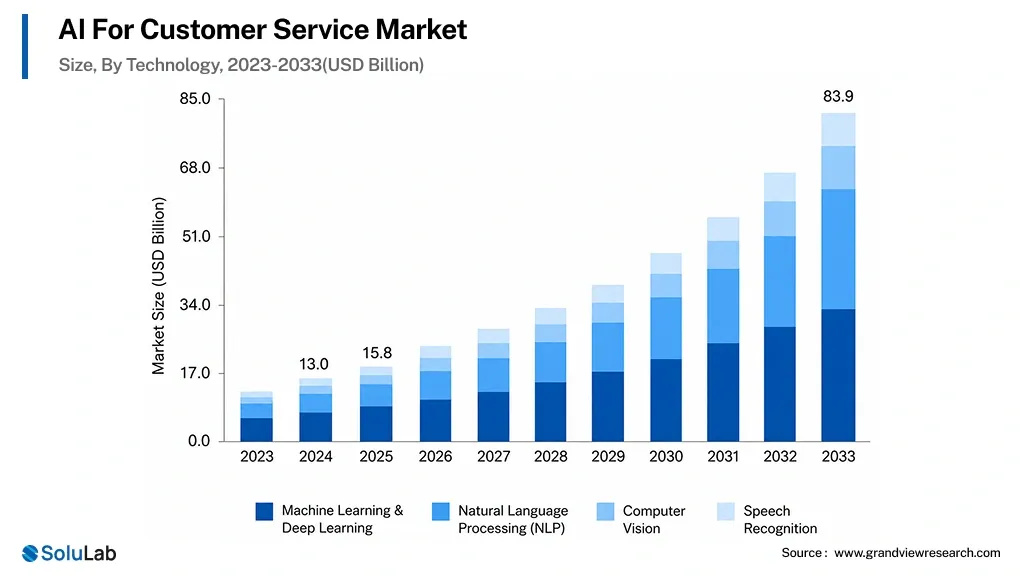
They use AI to work out what a customer is asking, give a correct answer, and finish the job without someone watching over every step. The money is following. Grand View Research estimates the global AI for customer service market will grow $83.8 billion by 2033.
Day to day, support teams tend to put AI agents on jobs like these:
- Answering questions the moment they come in
- Routing tickets and deciding what goes first
- Supporting customers in several languages
- Order tracking and refunds
- Booking appointments automatically
Why Businesses Are Investing in AI Customer Service Agents?
Why the rush? Demand keeps climbing, teams are stretched, and customers expect quick, personal help on every digital channel at every hour. AI customer service agents answer all of that at once, which is why more companies are bringing them in.
- Rising customer expectations: People now want support that’s instant, personal, and right the first time, on whatever platform they use. AI agents are how many companies keep up with that bar.
- High support operational costs: A big support team costs a lot to run. Handing repetitive questions to AI agents trims that staffing overhead without cutting corners.
- Need for 24/7 support: If your customers live in different time zones, somebody has to be awake. AI agents are, always, with no shift rota to juggle.
- Omnichannel communication challenges: Email, chat, social, website, phone. Keeping track of one customer across all of them gets messy fast, and AI agents pull those threads together.
- Growing ticket volumes: Traditional teams get buried. AI agents sort, solve, and route tickets quicker, and they do it the same way every time.
- Customer retention pressure: Keeping customers now means quick replies, personal attention, and fixing problems before they’re reported. AI agents can do all three at scale.

What Business Impact Are AI Agents Creating in Customer Service?
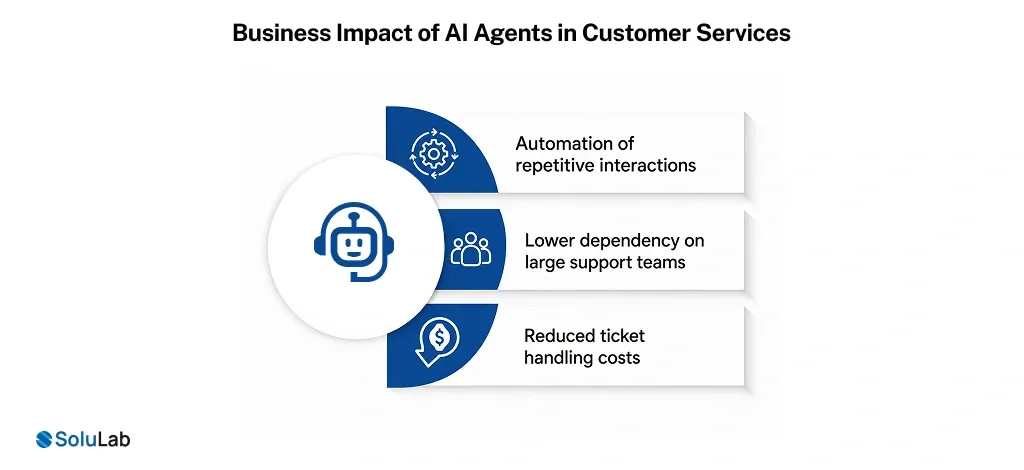
The changes show up quickly. Workflows run themselves, teams breathe easier, replies get sharper, and the business can support customers around the clock without scaling headcount to match.
- Automation of repetitive interactions: FAQs, order updates, appointment booking, password resets, basic troubleshooting. AI agents handle these on their own, and a huge share of the grind disappears from your support queue.
- Lower dependency on large support teams: As volumes grow, AI agents absorb the extra load. You don’t need a giant team to keep reply quality and availability steady.
- Reduced ticket handling costs: Less manual ticket work, shorter time to resolution, and people spent where they’re actually needed. Costs come down across the whole support operation.
How to Successfully Implement AI Agents in Customer Service
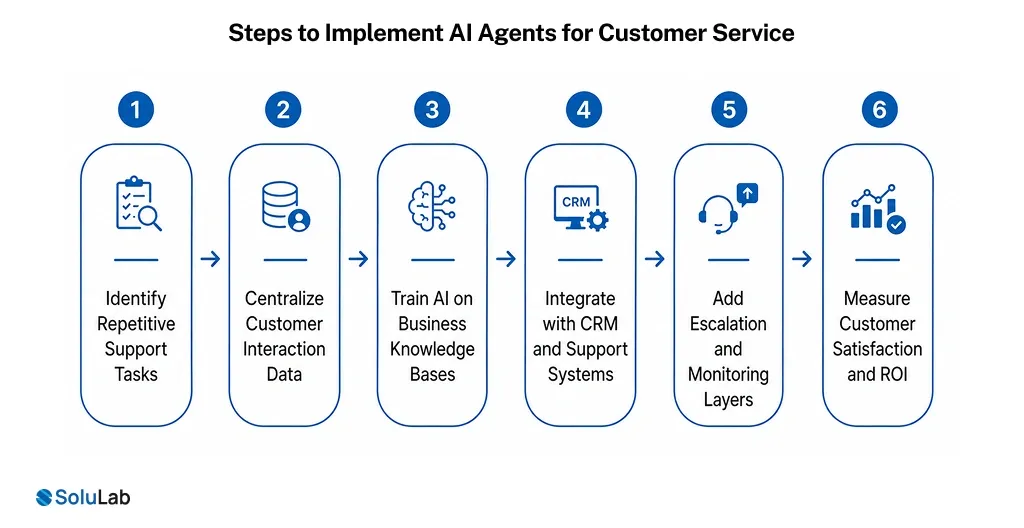
Done well, AI agents give you faster support, fewer repetitive chats, more accurate answers, and a way to handle huge volumes of conversation while every customer still feels personally looked after. Done badly, they frustrate everyone. The difference usually comes down to the rollout, so here’s the order we’d follow.
1. Identify Repetitive Support Tasks
Start with your own data. Look at which questions keep coming back, which ticket categories pile up, and which workflows people still do by hand. The high-volume stuff is where an AI agent pays off first.
2. Centralize Customer Interaction Data
Bring conversations, tickets, CRM records, and message history into one system. An agent can only give a good answer if it can see the full picture in real time, and in practice, scattered data is where most teams get stuck.
3. Train AI on Business Knowledge Bases
Feed the agent what your best reps already know: FAQs, policy documents, product manuals, old tickets, the steps you follow for each workflow. The better the material, the better it understands your business.
4. Integrate with CRM and Support Systems
Hook the agents into your CRM, help desk, live chat, and other business apps. That’s what lets them act on customer data and automate the workflow, not just talk about it.
5. Add Escalation and Monitoring Layers
Some issues need a person. Set up clear handoffs to humans, keep an eye on quality, and put performance controls in place, so tricky cases move to the right agent quickly and service doesn’t slip.
6. Measure Customer Satisfaction and ROI
Keep score. Satisfaction ratings, response times, automation rates, cost savings, support efficiency: together they tell you whether the agent is earning its keep.
Use Cases of AI in Customer Service
AI is reshaping customer service quickly. Here are some of the ways companies are using it to give customers a better experience:
1. Virtual Assistants and Chatbots
AI-powered chatbots and virtual assistants have grown far more capable. They process orders, walk people through common problems, and answer the usual questions. They’re also always on. Customers skip the wait, and they’re happier for it.
2. Sentiment Analysis
Sentiment tools powered by AI read through social media posts, reviews, and survey answers to figure out how customers actually feel. The findings cut both ways. Praise is something you can build on. Complaints point straight at the parts of the business that need fixing.
3. Analytical Forecasting
By studying customer data, AI use cases can predict what people will do and what they’ll prefer. That lets you see needs coming, make tailored recommendations, and head off problems early. Say a product is likely to fail soon: AI can flag it. Or it can suggest items based on what a customer bought before.
4. Computerized Customer Support
Order tracking, password resets, booking appointments. None of that needs a human, and AI-driven automation can take it off the pile. Your people then get their time back for the hard, messy questions, which lifts efficiency and satisfaction together.
5. AI-Powered Email Automation
Some inboxes get more mail than any team can read. AI email automation reads and answers those messages as they arrive, so customers aren’t left hanging. It can also sort incoming email into separate datasets for you.
6. Optimized Customer Service
Your past support conversations are a goldmine, and AI can dig through them to show where things need work. Call logs, chat transcripts, and similar records reveal the problems that keep coming up, help you smooth out workflows, and give you real material to train staff on.
7. Targeted Advertisement
The same customer data can shape very focused marketing. Once AI has looked at a client’s interests, behavior, and purchase history, you can send offers and messages built for that one person.
That’s the theory. What does it look like when real companies put AI to work in customer service?
Examples of AI in Customer Service
Here are a few businesses already running an AI agent in customer service:
1. H&M’s AI Chatbot
H&M runs an AI chatbot that gives shoppers instant help: product questions, order support, and a smoother online shopping experience, all through automated chat.
It takes the common questions around the clock, 24/7. Wait times drop, and human agents get to spend their energy on the complicated cases, where they add the most.
2. Obvi
Obvi is a fast-growing health and wellness brand. It uses AI to lighten the support load, handling thousands of customer requests automatically and answering more efficiently month after month.
Every month, AI tags and triages more than 10,000 support tickets on its own. The team sees urgent issues first, does less manual sorting, and gets back to customers faster.
3. NICE Enlighten AI
NICE Enlighten AI works inside contact centers. It analyzes conversations, coaches agents while the call is still happening, and surfaces insights that lift both customer satisfaction and agent performance.
It scores each customer interaction, gives live coaching, and spots where things could be better, so the organization can offer support that’s faster, more personal, and more consistent.
4. Verizon
Verizon relies on AI virtual agents and service tools to automate routine questions, personalize conversations, and keep support running day and night across several channels.
Those virtual agents clear the everyday requests and pass the complicated ones to a human without dropping the thread. Customers get support that’s quicker, more personal, and there whenever they need it.
How to Integrate AI Agents in Existing Workflows?
You don’t have to rip out what you already have. AI agents slot into current workflows, take over the repetitive steps, cut down on manual work, and speed up decisions, all while your existing systems and infrastructure stay in place.
- Pick out the repetitive tasks worth automating
- Plug AI agents into the business systems you already use
- Bring operational and customer workflow data into one place
- Train the AI on your past business interactions
- Set up monitoring, escalation, and sign-off steps
- Keep tuning workflows based on what the performance data shows
Future Trends in AI Customer Service Agents
Support bots used to just answer questions. That’s changing quickly. The next wave can pick up on emotion, predict what a customer needs, and run personalized experiences at scale largely on its own.
- Voice-based AI agents: AI voice agent systems make natural spoken conversations possible. Support becomes faster, hands-free, multilingual, and close to talking with a person, on channels around the world.
- Emotion-aware AI systems: More agents now read tone, sentiment, and behavior. They respond with more empathy, which lifts satisfaction and takes the edge off frustrating support calls.
- Autonomous customer success agents: Companies are starting to hand onboarding, renewals, issue resolution, and engagement to AI agents that act ahead of time and don’t need a human checking in constantly.
- AI-powered hyper-personalization: By drawing on customer history, behavior data, and live preferences, AI agents tailor recommendations, replies, and support to each person across digital platforms.
- Multi-agent customer support teams: Some organizations now run multiple interconnected AI agents that work together across departments, covering sales, support, billing, and technical service between them.
- Predictive customer service: Here’s the big one. AI can spot a problem before the customer ever reports it, which means fewer complaints, better retention, and fixes that happen in real time instead of after the fact.
How SoluLab Helps Businesses Build AI Customer Service Agents
Getting an AI agent system ready for production is hard. You need people who know the models, the architecture, and the integrations. SoluLab designs AI systems that scale, stay secure, perform well, and fit the way your business actually works.
What we build:
- Custom AI agent systems
- Orchestration across multiple agents
- LLM fine-tuning + RAG pipelines
- Enterprise integrations (CRM, ERP, APIs)
- AI deployment and scaling
- Ongoing monitoring and tuning
One example: SoluLab built CyberHulk, an AI marketing SaaS platform that brought campaign management, lead generation, analytics, and workflow automation under one roof.
Because several marketing tools now lived in a single system, CyberHulk helped businesses cut manual work, get better leads, and make faster growth decisions backed by data on every channel.

Conclusion
Customer expectations keep going up. So do ticket counts. For most support teams, AI agents are no longer optional: they automate the workflows, sharpen the answers, and deliver fast help at a volume people alone can’t match.
Whether it’s ticket handling or one-to-one conversations, AI-driven support takes weight off the team without letting service quality drop.
The companies moving now are pulling ahead on efficiency, on availability, and on the quality of the decisions they make.
If you want agents shaped around your own support workflows and enterprise needs, SoluLab, an AI agent development company, can build them with you, and build them to scale.
FAQs
Neha is a curious content writer with a knack for breaking down complex technologies into meaningful, reader-friendly insights. With experience in blockchain, digital assets, and enterprise tech, she focuses on creating content that informs, connects, and supports strategic decision-making.