Key Takeaways
- AI in banking means using machine learning, generative AI and AI agents to fight fraud, assess credit, serve customers and automate operations.
- Fraud detection, customer service and onboarding deliver the fastest measurable returns.
- Bank of America’s Erica has passed 3 billion client interactions, and JPMorgan onboarded 200,000 employees to its LLM Suite within eight months.
- McKinsey estimates generative AI could add $200 billion to $340 billion a year in value to banking.
- The EU AI Act’s high-risk rules for credit scoring now apply from 2 December 2027, and US regulators replaced SR 11-7 with new model risk guidance in April 2026.
- Start with one use case and a measurable KPI. Integrating with your core banking system is usually the biggest cost driver.
AI in banking is the use of machine learning, generative AI and AI agents to detect fraud, assess credit, serve customers and automate back-office work. Banks see the fastest returns in fraud detection, customer service and onboarding, where results show up within months. The hard parts are data quality, legacy core systems and regulation.
This guide covers how banks actually use artificial intelligence in 2026, with named examples, numbers from our own banking projects, what it costs, where to deploy it and which rules changed this year.
What Is AI in Banking?
AI in banking is the application of machine learning models, large language models (LLMs) and autonomous AI agents to banking data and workflows, so that a bank can predict risk, generate answers and complete routine tasks with less manual effort and fewer errors.
Artificial intelligence for banking: the use of machine learning, natural language processing, generative AI and automation to help banks detect risk, serve customers and run operations.
AI banking solutions: the specific systems built on that technology, such as fraud engines, credit models, chatbots, onboarding automation and analytics dashboards.
The scope here is AI across retail and commercial banking. For the wider view of AI in banking and finance, including lending, payments and wealth, see our guide to generative AI in banking and finance. For autonomous workflows, see AI agents in banking.
Most banks now run three kinds of AI side by side. They solve different problems, so it helps to separate them before choosing a project.
1. Predictive Machine Learning
This is the oldest and most proven layer. Models trained on historical transactions score fraud risk, predict loan defaults and segment customers. Algorithms like gradient boosting (XGBoost) and neural networks run behind most fraud and credit decisions today.
2. Generative AI
Generative AI uses LLMs to read, summarize and write. In a bank, that means answering customer questions, drafting credit memos, summarizing call transcripts and searching policy documents. It is strong with language and weak at exact arithmetic, which shapes where you should use it.
3. Agentic AI
AI agents take actions, not just answers. An agent can collect a customer’s documents, check them against KYC rules, open a case and route it to an analyst. We cover orchestration patterns in our guide to agentic AI orchestration for banking.
How Is AI Used in Banking? 10 Use Cases With Real Results
Banks use AI most in fraud prevention, customer service, onboarding, lending and operations. The table gives a quick view, and each use case below includes a result from a live system.
| Use case | AI type | Typical KPI | Data you need |
|---|---|---|---|
| Fraud detection and AML | Predictive ML | Fraud losses, false positives | Transaction history, device data |
| Chatbots and voice assistants | Generative AI | Containment rate, call volume | FAQs, product docs, core APIs |
| Digital onboarding and KYC | Computer vision + ML | Time to open an account | ID documents, sanctions lists |
| Credit scoring and underwriting | Predictive ML | Approval time, default rate | Bureau data, bank statements |
| Risk management | Predictive ML | Model accuracy, stress-test speed | Portfolio and market data |
| Document processing | Generative AI + OCR | Hours saved per document | Contracts, statements, forms |
| Personalized offers | Predictive ML | Product uptake | Spending and product data |
| Employee copilots | Generative AI | Time saved per task | Policies, procedures, knowledge base |
| Operations automation | Agentic AI | Case resolution time | Workflow and ticket data |
| Cybersecurity | Predictive ML | Time to detect threats | Network and access logs |
1. Fraud Detection and Anti-Money Laundering
AI flags suspicious transactions in milliseconds by comparing each payment with a customer’s normal behavior. Visa says its AI tools helped prevent about $40 billion in fraud in 2023 (Payment Expert). For a digital bank, we built a real-time fraud platform on TensorFlow, Kafka and Redis that cut fraud losses by 58%, reached 92% detection accuracy and made investigations 67% faster.
2. AI Chatbots and Voice Assistants
Conversational AI handles balance checks, card blocks and transfers around the clock. A voice banking assistant we delivered for a retail bank, built on Whisper, Twilio and Azure Speech Services, reduced call-center volume by 57% and resolved 81% of queries without an agent. If you’re planning one, our chatbot development team starts by mapping the intents behind most of your call volume.
3. Digital Onboarding and KYC
Computer vision reads ID documents, matches them with a selfie and checks sanctions lists before a person ever reviews the file. Done well, account opening drops from days to minutes. The trade-off is that false rejections frustrate good customers, so every automated “no” needs a fast human review path.
4. Credit Scoring and Loan Underwriting
Machine learning models combine bureau data, bank statements and cash-flow patterns to score borrowers, including people with thin credit files. For a consumer lender, our underwriting platform (Python, XGBoost, Snowflake) delivered 61% faster loan approvals and 32% lower default risk. The full workflow is covered in our guide to AI in loan underwriting.
5. Risk Management and Stress Testing
AI speeds up credit, market and liquidity risk models and lets risk teams run more stress scenarios in less time. The constraint is explainability: risk models must be documented and validated before regulators accept them. See how this works in AI in risk management.
6. Document Processing
Generative AI combined with OCR reads loan agreements, statements and trade documents, then pulls out the fields that matter. JPMorgan’s COiN platform reviews commercial loan agreements, work that once took lawyers and loan officers about 360,000 hours a year (ABA Journal).
7. Personalized Offers and Customer Segmentation
Models group customers by behavior instead of just age or income, then predict which product each person needs next. A customer who just received a large deposit might see a savings offer, not a credit card ad. It’s one of the main revenue levers for AI in retail banking.
8. Employee Copilots
Internal AI assistants answer staff questions about policies and procedures, and draft emails and reports. Bank of America says its Erica for Employees tool is used by more than 90% of employees and has cut IT service desk calls by 50% (Bank of America).
9. Back-Office Operations Automation
AI agents coordinate servicing requests, exception handling and compliance checks across systems that don’t talk to each other. For a bank running Temenos and Fiserv APIs, our agent-based operations platform delivered 62% faster case resolution and 48% less manual processing. For more patterns, see AI agents in banking.
10. Cybersecurity
AI monitors network traffic and login behavior to spot account takeovers and intrusions faster than rule-based tools. It also introduces new risks. Prompt injection and data leakage through chatbots now belong in every bank’s threat model.
Not sure which use case to start with? Book a free AI use-case workshop for your bank. Our architects will rank your top three ideas by ROI and data readiness.
Examples of Banks Using AI in 2026
The banks furthest ahead treat AI as infrastructure, not a pilot. Here are four examples with published results.
1. Bank of America: Erica
Erica, launched in 2018, has passed 3 billion client interactions and nearly 50 million users, and now averages more than 58 million interactions a month. Bank of America reports that more than 98% of users find the information they need.
2. JPMorgan Chase: COiN and LLM Suite
Beyond COiN, JPMorgan made its LLM Suite available firmwide in summer 2024 and reached 200,000 onboarded users within eight months (JPMorganChase). The lesson for smaller banks: a single secure internal gateway to LLMs beats dozens of disconnected pilots.
3. Visa: Network-Level Fraud Prevention
Visa isn’t a bank, but its AI runs on every card transaction banks process. The roughly $40 billion in fraud it says it prevented in 2023 shows what models trained on network-scale data can do.
4. Amanbank: Generative AI Mobile Banking
Amanbank, which serves around 750,000 customers, worked with SoluLab to add an AI chatbot and voice agents to its mobile app. The result was 60% faster onboarding, a 50% lighter support workload and 20% higher digital banking adoption. Read the Amanbank generative AI mobile banking case study.
“SoluLab helped us bring AI directly into the banking experience. From customer onboarding and account assistance to money transfers and card requests, the AI chatbot and voice agents gave customers a much faster way to complete everyday banking tasks. The solution helped us reduce onboarding time while taking significant pressure off our support teams.” Rashid Daoudi, CEO, Amanbank (Generative AI Mobile Banking Platform)
Benefits of Artificial Intelligence in banking
The main benefits of artificial intelligence in banking are lower fraud losses, faster decisions, lower operating costs and always-on service. Each one below is tied to a measured outcome, not a promise.
1. Lower Fraud Losses
Real-time scoring catches fraud before money leaves the account. Our digital bank client cut fraud losses by 58%.
2. Faster Lending Decisions
Automated document checks and credit scoring turn multi-day approvals into same-day decisions. Our lending client saw 61% faster approvals.
3. Lower Service Costs
Chatbots and voice agents absorb routine questions so staff handle complex ones. The retail bank voice assistant cut call volume by 57%.
4. Better Customer Experience
Customers get answers at 2 a.m. without waiting on hold. Amanbank’s digital adoption rose 20% after launch.
5. More Inclusive Credit
Cash-flow and alternative data help score borrowers that traditional bureau models miss. This needs careful fairness testing (see the regulation section).
6. Productive Employees
Internal copilots cut the time staff spend searching for policies and writing routine documents, as Bank of America’s 50% drop in IT desk calls shows.
Generative AI in Banking: Where It Helps and Where It Doesn’t
Generative AI in banking works best for language-heavy tasks such as service, document review, research summaries and internal search. It works poorly as the sole decision-maker for credit or compliance. McKinsey estimates generative AI could add $200 billion to $340 billion a year to banking, equal to 9% to 15% of operating profits (McKinsey).
1. Where It Helps
Drafting credit memos and suitability letters. Summarizing customer calls for QA teams. Answering staff questions from thousands of policy pages using retrieval-augmented generation (RAG), where the model answers only from approved documents. Translating product documents for multilingual markets like the UAE.
2. Where It Falls Short
LLMs can produce confident wrong answers. In a bank, a chatbot inventing a fee or interest rate is a conduct risk, not a typo. Credit decisions also need specific, explainable reasons, because US fair lending rules (ECOA and Regulation B) require lenders to tell applicants why they were declined. Use generative AI to support those decisions, and keep scoring in validated, explainable models.
How Does Generative AI Change Traditional Banking?
Older banking software follows rules someone wrote years ago. Generative AI can produce new content, play out what-if scenarios and pull insight from large piles of data, so a bank can automate smarter, personalize at scale and decide faster. Five places it shows up first:
1. Customer relationships. Banks are building and deploying AI chatbots so customers get help at 3 a.m. and routine questions are handled without a person in the loop.
2. Fraud prevention. Fraud is rare, which makes it hard to train a model on. Generative AI gets around that with synthetic data: banks create realistic examples of odd behavior and teach models to spot the patterns that usually mean trouble.
3. Risk assessment. What happens to a loan book if rates jump and unemployment climbs together? Generative AI can run that scenario, and dozens more, to show where the exposure sits. AI in BFSI work also helps banks stress test portfolios.
4. Personalized financial advice. AI advisors suggest investments based on how much risk a person can stomach and what they are saving for. Generative AI goes a step further by building personalized financial strategies.
5. Sales and marketing. Mining customer data, AI helps banks aim campaigns at the right people and tune offers to the individual, which lifts engagement and conversion.
AI in Retail, Corporate, Investment and Community Banking
The right AI starting point changes with the type of bank. Here’s where each segment usually gets value first.
1. Retail Banking
High volumes of similar requests make retail the natural home for chatbots, onboarding automation and personalized offers. Measure containment rate and cost per contact.
2. Corporate and Commercial Banking
Fewer customers, bigger documents. AI helps with credit memo drafting, covenant monitoring and cash-flow forecasting for business clients.
3. Investment and Private Banking
Research summarization, pitch book drafting and advisor copilots lead here. Data confidentiality is the deciding factor, so private deployments are common.
4. Community Banks and Credit Unions
AI automation for community banks starts with what their core vendor already supports. Most run on Fiserv, Jack Henry or FIS, so the fastest wins are hosted fraud tools, chatbots connected through vendor APIs and document processing for loan files. Building custom models rarely makes sense below a certain transaction volume.
Cloud, Private or On-Premise AI: Which Deployment Fits Your Bank?
Many banks end up with a hybrid setup: managed cloud AI for low-risk tasks, and private or on-premise models where customer data or regulation demands full control. Here’s how the options compare.
| Option | Example stack | Data control | Cost profile | Best for |
|---|---|---|---|---|
| Managed cloud AI | Azure OpenAI, Google Vertex AI, AWS Bedrock | Data stays in your cloud tenant under contract | Pay per use, low setup | Chatbots, internal copilots, document drafts |
| Private cloud (VPC) | Open-weight models such as Llama or Mistral hosted in your own cloud account | High | Fixed GPU cost plus engineering | Sensitive data with cloud flexibility |
| On-premise AI | Open-weight models on bank-owned GPU servers | Full | Highest upfront cost | Strict data residency, core risk models |
| Hybrid | Cloud for general tasks, on-premise for regulated data | Mixed, routed by data class | Balanced | Most mid-size and large banks |
On-premise AI for banks has grown because open-weight models now handle many tasks that once required a hosted frontier model. The trade-off is that you own patching, monitoring and GPU capacity. We explain the architecture in our guide to hybrid AI.
Weighing cloud against on-premise? Talk to a banking AI architect about your data residency and security requirements. (Button: “Talk to a Banking AI Architect”, linked to the contact form on this page.)
AI Regulation in Banking: What Changed in 2026
AI governance in banking got a new timeline in 2026. In the EU, high-risk obligations for credit scoring were delayed to December 2027. In the US, regulators replaced their 15-year-old model risk guidance. Plan for both now, even where the deadlines feel distant.
1. EU AI Act: High-Risk Deadline Moved to 2 December 2027
AI used to assess the creditworthiness of individuals is classed as high-risk under the EU AI Act. The Digital Omnibus amendments, approved by the European Parliament on 16 June 2026 and in force since 27 July 2026, moved those obligations from 2 August 2026 to 2 December 2027 (Morgan Lewis). The requirements themselves (risk management, data governance, human oversight, logging) didn’t go away.
2. US: New Model Risk Management Guidance Replaces SR 11-7
On 17 April 2026, the OCC, Federal Reserve and FDIC issued revised model risk management guidance that rescinds SR 11-7 and OCC Bulletin 2011-12. It’s framed as most relevant to banks with more than $30 billion in assets, and it explicitly leaves generative and agentic AI out of scope for now, with a request for information on AI to follow (Orrick). That gap doesn’t mean “no rules”. Examiners still expect sound governance over any tool that touches customers.
3. Controls Every Bank Should Have Anyway
Whatever the jurisdiction, these four controls are the baseline auditors and examiners look for:
- A model inventory listing every AI system, its owner and its risk tier.
- Explainable outputs for any decision that affects a customer, with reason codes for declined applications.
- Human review for high-impact actions such as account closures, large transfers and credit declines.
- Logging of prompts, outputs and data sources, so you can reconstruct any answer a chatbot gave.
How to Implement AI in a Bank: A 6-Step Roadmap
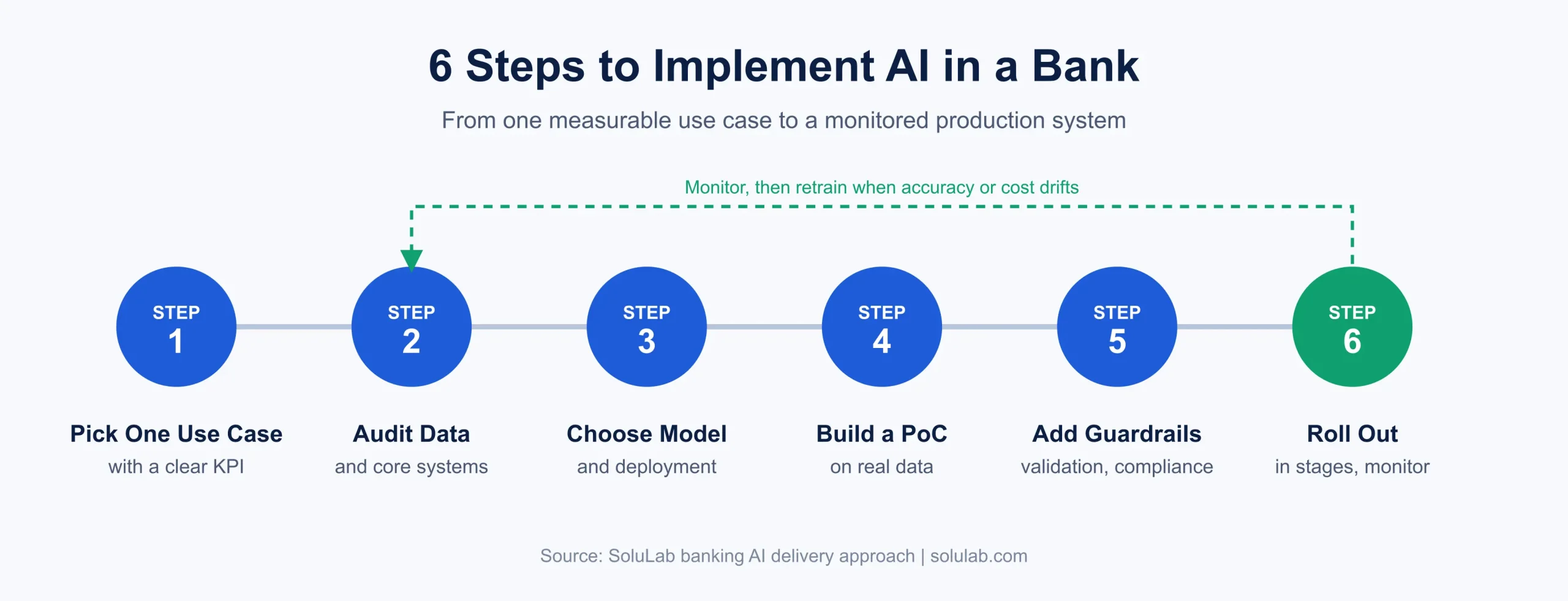
The banks that get AI into production follow the same sequence: one measurable use case, a data check, a scored proof of concept, then a controlled rollout. Skipping the data step is the most common reason pilots stall.
Step 1: Pick One Use Case With a Clear KPI
Choose a problem with a number attached, such as fraud losses, average handle time or days to approve a loan. “Use AI more” isn’t a use case.
Step 2: Audit Your Data and Core Systems
Check data quality, access rights and how your core banking system exposes data (real-time APIs or overnight batch files). This decides your architecture more than the model does.
Step 3: Choose the Model and Deployment
Decide between managed cloud, private or on-premise models based on data sensitivity (see the table above). Compare at least two models on accuracy, cost per request and latency.
Step 4: Build a Proof of Concept on Real Data
Test against your own historical data and score it on the KPI from Step 1. A proof of concept that only runs on sample data proves very little.
Step 5: Add Guardrails, Validation and Compliance Review
Run bias and fairness tests, red-team the chatbot, document the model for your risk team and set human-review thresholds before any customer sees it.
Step 6: Roll Out in Stages and Monitor
Launch to a small share of customers or one branch first. Monitor drift, accuracy and cost per transaction every week, and retrain when performance slips.
Want a plan you can take to your board? Get a fixed-scope AI proof-of-concept plan with costs, timelines and success metrics for your first use case.
What Are the Main Benefits of AI in Banking?
Well-chosen AI solutions for banking pay off in a handful of places. These matter most:
| Benefit | What AI does | Typical example |
|---|---|---|
| Personalized banking | Reads client data and shapes products and offers | Investment suggestions that match goals and risk tolerance |
| 24/7 support | Chatbots and voice assistants answer at any hour | Balance, card and transfer queries with no queue |
| Faster onboarding | Automates identity and document checks | KYC with OCR document verification |
| Fewer manual errors | Replaces re-keying and manual checks | Cleaner loan and compliance files |
| Process automation | Takes over data entry, loan processing and compliance checks | Staff freed for work that needs judgment |
| Risk assessment and credit scoring | Weighs market, economic and alternative data | More inclusive credit models |
| Fraud detection | Scans transaction streams and flags anomalies in time to stop loss | Real-time alerts to compliance teams |
| Predictive analytics and market analysis | Forecasts demand and spots new customer niches | Earlier product and campaign decisions |
Costs tend to fall as a side effect, because fewer manual steps and fewer errors add up. The size of the saving depends on the bank, so measure it against a baseline. Better customer service automation and clearer use cases of AI agents are the usual starting points.
How Does AI Fit Into Digital Banking?
AI digital banking is where most customers meet the technology first. Think of the assistant inside the mobile app, the card block that happens before you notice the fraud, and the savings nudge that arrives when your balance allows it.
Digital banking AI also works behind the screen. It scores applications, routes service requests and flags suspicious logins. The customer sees a faster answer. The bank sees fewer manual touches.
The common mistake is to bolt a chatbot onto the app and call it a strategy. The assistant needs live access to accounts, cards and policies, and a clean hand-off to a human when it is unsure. We show a real example further down.
What Does AI Banking Infrastructure Look Like?
Buying a model is the easy part. The foundation under it is harder. An AI banking infrastructure solution usually has four layers:
- Data layer: governed, access-controlled data from core banking, cards, CRM and digital channels.
- Model layer: a mix of hosted, open-source and in-house models chosen per use case.
- Integration layer: APIs and event streams that connect models to core systems and channels.
- Governance and security layer: encryption, role-based access, audit logging, model monitoring and human review of high-impact decisions.
Most banks end up with a hybrid cloud setup, which lets workloads move between public and private clouds. That gives digital banking the scale and resilience it needs while keeping sensitive data where policy says it must stay.
Banking AI solutions that skip the governance layer tend to stall at risk review, so design it from day one. Supervisors expect model risk management, as set out in the US guidance SR 11-7, and under the EU AI Act systems that assess the creditworthiness of individuals are classed as high-risk [VERIFY both URLs and the classification wording with compliance].
How Much Does AI in Banking Cost?
AI in banking projects usually cost more than the same build in other industries because of core-system integration, security reviews and model validation. SoluLab’s published pricing for AI builds starts at $10,000 to $20,000 for an MVP, and enterprise systems start at $35,000. Most bank production projects land in that enterprise tier.
| Cost driver | Lower cost | Higher cost |
|---|---|---|
| Core banking integration | Modern core with real-time APIs | Legacy core, batch files, middleware |
| Model approach | Managed LLM with RAG | Custom-trained or fine-tuned models |
| Deployment | Managed cloud | On-premise GPUs |
| Compliance scope | Internal tool, no customer data | Credit decisions, EU high-risk scope |
| Autonomy | AI suggests, staff decide | AI agent acts on accounts |
| Languages and channels | One language, chat only | Multilingual, chat plus voice |
Budget for running costs too: model usage or GPU hosting, monitoring, retraining and periodic validation. These recur every month and grow with transaction volume. Our AI consulting services include a cost model for both the build and the first year of operation.
Risks and Limitations of AI in Banking
AI creates real risks for banks: biased credit decisions, hallucinated answers, data leakage and dependence on a single vendor. None of them is a reason to avoid AI. Each one needs a named owner and a control.
1. Bias in Credit and Pricing
Models trained on historical decisions can repeat historical bias. Test approval rates across protected groups before launch and on a regular schedule afterwards.
2. Hallucinations
A chatbot that invents a policy creates a conduct risk. Restrict answers to approved documents and add a fallback to a human agent.
3. Legacy Core Systems
Many banks still run decades-old cores. Without APIs, even a strong model can’t act in real time, so integration often takes longer than the AI work itself.
4. Vendor Lock-In
Contract for ownership of your prompts, fine-tuned weights and evaluation data, and keep a second model option tested.
5. Model Drift
Fraud patterns change fast. A model that was 92% accurate in January can slip by summer if nobody monitors it.
The Future of AI in Banking
The future of AI in banking is agentic: systems that complete whole workflows such as onboarding, dispute handling and loan servicing, with staff supervising exceptions rather than doing every step. Expect three shifts over the next few years. Agents will take over multi-step servicing tasks. Private, on-premise models will become standard for regulated data. And AI governance will become a board-level function, as the EU deadlines and US rules settle. Banks that have clean data and clear model governance will move fastest, whatever their size. For the wider picture beyond banking, see our guide to AI in finance.
How Should Banks Approach AI Integration?
AI integration for banks works best when AI connects to the systems that already run the bank. A chatbot that can’t see the account balance, or a fraud model that can’t block a payment, is a demo, not a product. Our AI integration services team follows five steps:
- Pick one use case with a measurable metric and a baseline, such as fraud losses, onboarding time or handling time.
- Map the data and systems involved: core banking, card processor, CRM and KYC provider.
- Prove it on your own data in a short proof of concept with exit criteria agreed up front.
- Integrate through APIs or an event layer, with logging, role-based access and a human fallback.
- Monitor accuracy, latency and cost after launch, and retrain or adjust as data drifts.
In practice, step 2 is where teams get stuck. Vague ambitions like use AI everywhere rarely survive the first budget review.
When Does a Bank Need AI Consulting?
Not every bank needs a consultant. A bank with a data science team, a clear use case and a vendor shortlist may only need engineering help. AI consulting for banking is worth it when the use case is unclear, data readiness is unknown, or risk and compliance teams need convincing before anything ships.
An AI banking consultant typically ranks use cases by value and feasibility, audits the data, designs the target architecture, maps controls to regulation and builds the business case. AI in banking consulting engagements often end with a costed roadmap that engineering can start from. An AI readiness assessment is a common first step, and our AI consulting team runs these for banks.
AI consulting banking checklist: questions to ask any consultant
- Which banking projects have you taken to production, and what were the measured results?
- How do you handle model risk management and audit evidence?
- Who owns the code, prompts and evaluation sets afterwards?
- How will you test on our data before we commit to a build?
What Risks and Trade-Offs Should Banks Weigh?
AI is not free of cost or risk. Data privacy and security come first, which means clear privacy rules, strong encryption and regular security reviews. Models can be wrong, and in credit decisions they must also be explainable. Biased training data can lock unfair patterns into lending. Model usage costs grow with traffic. Regulation keeps moving.
And sometimes AI is the wrong tool. For low-volume, rule-stable processes, plain automation is cheaper and easier to audit. The skill is knowing which problems deserve a model.
What Does the Future of Banking Look Like With AI?
Artificial intelligence and banking will keep converging, and the classic bank will start to look more like a digital hub organized around the customer. For leaders of the banking industry, AI for banking industry operations will matter most in five areas:
- Hyper-personalized experiences: advice, products and offers that fit each customer in real time.
- Highly automated operations: loan approvals, compliance checks and onboarding that run faster, cost less and produce fewer mistakes.
- Predictive and proactive service: early fraud alerts and tailored plans instead of reactions after the problem.
- Omnichannel continuity: start in the app, finish with an agent or voice assistant, and never repeat yourself.
- Wider financial inclusion: lower costs and simpler access for underserved customers.
For teams in banking and finance, AI for banking and finance will be less a project and more a standing capability.
How SoluLab Helps Banks Put AI Into Production
SoluLab is an AI consulting and engineering company that builds production AI for banks, lenders and fintechs, from fraud detection and underwriting to chatbots, voice agents and agent-based operations. We start with discovery and a data audit, prove value with a scored proof of concept, then integrate with your core banking stack under your security and compliance rules.
Our banking work includes the Amanbank mobile banking platform, a real-time fraud platform for a digital bank, an underwriting system for a consumer lender and a voice assistant for a retail bank. Our AI development services cover the full lifecycle, and our machine learning development team builds the predictive models behind fraud and credit decisions. If you need extra capacity, you can hire AI developers with banking project experience.
Ready to start? Request a free AI readiness assessment for your bank. We’ll review your data, core systems and top use cases, and send you a prioritized roadmap.
FAQs
Shipra Garg is a tech-focused content strategist and copywriter specializing in Web3, blockchain, and artificial intelligence. She has worked with startups and enterprise teams to craft high-conversion content that bridges deep tech with business impact. Her work translates complex innovations into clear, credible, and engaging narratives that drive growth and build trust in emerging tech markets.