Key Takeaways
- The problem: Sales teams struggle to scale outreach without increasing costs. Manual prospecting, delayed follow-ups, and inconsistent messaging slow pipeline growth, while hiring more SDRs adds operational overhead without guaranteeing proportional results.
- The solution: AI SDRs automate lead generation, personalization, and follow-ups at scale. They engage prospects faster, maintain consistency, and qualify leads efficiently, helping businesses build a predictable sales pipeline without expanding team size.
- How SoluLab helps: As an AI-native company, SoluLab integrates AI directly into sales workflows to automate outreach, reduce manual effort, and accelerate execution—helping businesses scale faster while keeping costs significantly lower.
Your SDR team spends hours every day doing the same repetitive tasks: researching leads, sending cold emails, following up (again), and logging everything into the CRM. And after all that? Maybe a handful of qualified conversations a week.
So what does a better solution actually look like? Imagine having a sales rep that works 24/7, never misses a follow-up, personalizes outreach at scale, and hands your team only the warm, ready-to-talk leads.
That’s exactly what AI SDRs, built using advanced AI development services, are doing for businesses right now, and in 2026, the companies using them aren’t just saving time. They’re outpacing competitors who are still doing things the old way.
In fact, the global AI SDR market is projected to reach $5.22 billion in 2026, growing toward $24+ billion by 2034 at over 21% CAGR.
In this article, we’ll break down exactly what an AI SDR is, how it works, and why forward-thinking businesses are making it a core part of their sales engine.
What is an AI Sales Development Representative (SDR)?
An AI Sales Development Representative (AI SDR) is a software-powered sales assistant that automates lead generation, outreach, and qualification using artificial intelligence. It analyzes prospect data, personalizes communication at scale, and manages follow-ups across channels, helping businesses build pipeline faster while reducing manual sales effort.
83% of AI-enabled sales teams reported revenue growth, compared to 66% without AI.
Key Capabilities
- Automates lead sourcing and data enrichment
- Generates personalized outreach across email, LinkedIn, and more
- Runs multi-step follow-up sequences without manual input
- Qualifies leads using intent signals and predefined criteria
- Book meetings directly into sales calendars

How does an AI Sales Development Representative work?
AI SDRs operate like always-on digital teammates, combining data and automation to handle repetitive sales tasks while keeping outreach timely, relevant, and consistent across the funnel.
- Lead sourcing and enrichment: AI SDRs pull data from multiple sources, enrich prospect profiles with firmographic and behavioral insights, and build highly targeted lead lists aligned with defined ideal customer profiles.
- Intent signal tracking: They monitor signals such as website visits, content engagement, and buying-intent indicators, helping prioritize prospects more likely to convert rather than relying on static lists.
- Personalized outreach generation: Using AI models, they craft tailored emails, messages, and sequences based on prospect context, ensuring communication feels relevant while scaling personalization across hundreds or thousands of leads.
- Automated multi-channel follow-ups: AI SDRs manage consistent follow-ups across email, LinkedIn, and other channels, adjusting timing and messaging to improve response rates without manual intervention.
- Lead qualification and routing: They evaluate responses, qualify leads against predefined criteria, and route high-intent prospects directly to sales reps or calendars, reducing friction and speeding up pipeline movement.
What’s the difference between an AI SDR and a Human SDR?
AI SDRs and human SDRs serve the same goal, but they differ in how they execute outreach, scale operations, and engage with prospects across the sales funnel.
| Factor | AI SDR | Human SDR |
|---|---|---|
| Speed | Instant handles large volumes quickly | Slower, limited by workload |
| Scalability | Easily scales without hiring | Requires team expansion |
| Personalization | Data-driven, scalable | Emotion-driven, deeper context |
| Availability | 24/7 operation | Limited to working hours |
| Cost | Lower long-term cost | Higher ongoing cost |
| Consistency | Highly consistent execution | Can vary by performance |
| Decision-making | Rule and data-based | Intuition and experience-driven |
How to Implement AI SDR in Your Sales Workflow?
A practical rollout of AI SDR starts with clarity, not tools. When your sales workflow is structured well, AI native strategy implementation simply increases what already works instead of creating noise.
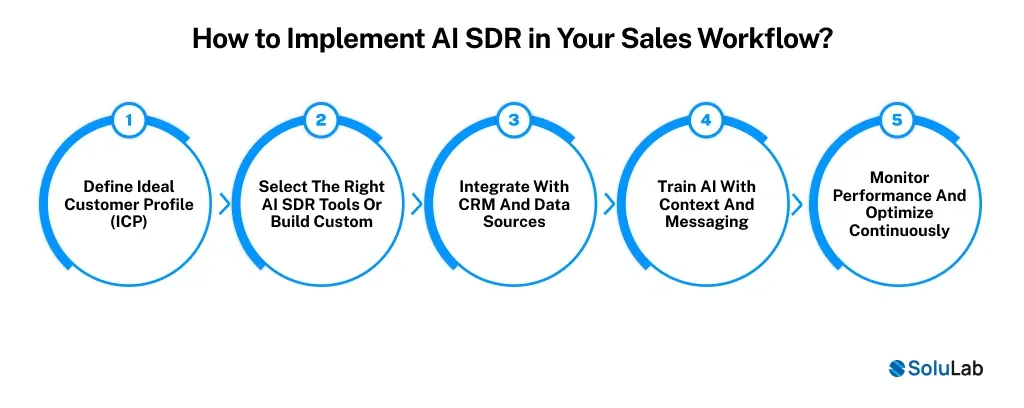
Step 1. Define Ideal Customer Profile (ICP)
Clearly outline your target audience using firmographics, behaviors, and buying signals. This ensures your AI SDR focuses on high-intent prospects instead of generic outreach, improving response rates and keeping your messaging relevant from the first touchpoint.
Step 2. Select the Right AI SDR Tools or Build Custom
Choose tools that align with your sales goals, AI tech stack, and scale requirements. Some businesses benefit from ready-made platforms, while others need custom-built AI SDR solutions for deeper personalization, integrations, and control over workflows.
Step 3. Integrate with CRM and Data Sources
Connect your AI SDR with your CRM, email systems, and data platforms. This creates a unified data flow, allowing the AI to access real-time prospect information, track interactions, and continuously improve outreach based on actual engagement.
Step 4. Train AI with Context and Messaging
Feed the system with your brand voice, past successful campaigns, and audience insights. Without proper context, AI integration can sound generic. Training ensures communication feels relevant, human-like, and aligned with your positioning.
Step 5. Monitor Performance and Optimize Continuously
Track metrics like open rates, replies, conversions, and meeting bookings. Use these insights to refine messaging, targeting, and workflows. AI SDR systems improve over time, but only if you actively guide and optimize their performance.
Read More: AI Sales Agent Development
Top Benefits of AI SDRs for Scalable Sales Automation
AI SDRs are reshaping how AI in sales helps teams build their pipeline, combining automation with smart decision-making to handle repetitive tasks while improving outreach quality, consistency, and overall conversion efficiency.
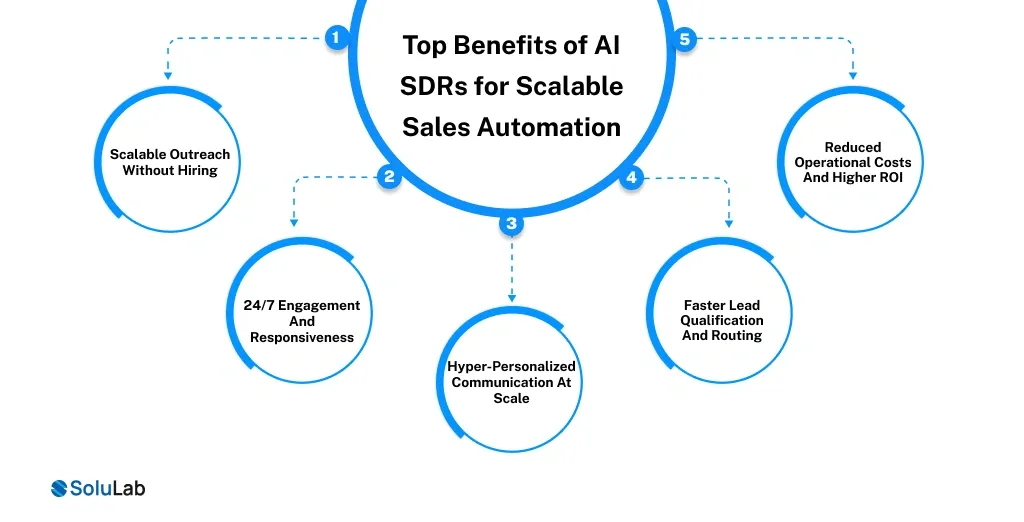
- Scalable outreach without hiring: AI SDR solutions enable teams to reach thousands of prospects simultaneously, removing dependency on team size while maintaining consistent messaging and ensuring no opportunity is missed.
- 24/7 engagement and responsiveness: An AI copilot for sales development representatives operates round the clock, instantly responding to leads, nurturing conversations, and maintaining engagement without delays across global time zones.
- Hyper-personalized communication at scale: AI SDR agent analyzes prospect data, behavior, and intent signals to craft tailored messages, making outreach feel relevant and human-like even when executed at high volume.
- Faster lead qualification and routing: AI SDRs evaluate lead quality using predefined criteria and behavioral insights, ensuring high-intent prospects are prioritized and quickly passed to sales teams for conversion.
- Reduced operational costs and higher ROI: By automating repetitive sales development tasks, AI SDRs lower dependency on large teams, reduce overhead costs, and improve overall efficiency of outbound and inbound sales processes.
How Can AI SDRs Improve Your Sales Processes?
AI SDRs are changing how sales teams operate by reducing manual work, improving targeting, and helping teams move faster from prospecting to closing deals without losing personalization.
1. Faster Lead Identification: AI agents scan large datasets to find high-intent prospects, reducing time spent on manual research and improving targeting accuracy.
- Saves prospecting time
- Improves targeting accuracy
2. Personalized Outreach at Scale: AI-powered sales development representative creates tailored messages using prospect data, making outreach feel relevant while handling volume effortlessly.
- Higher response rates
- Consistent messaging
3. Smarter Follow-Ups: Automates timely follow-ups based on behavior and engagement, ensuring no potential lead slips through the cracks.
- No missed opportunities
- Better engagement timing
4. Better Lead Qualification: Uses scoring models and intent signals to prioritize leads, improving conversion rates and saving sales team effort.
- Focus on high-value leads
- Improved conversions
5. Consistent Pipeline Growth: With AI SDR in lead generation, businesses maintain a steady flow of qualified leads without scaling headcount.
- Scalable growth
- Reduced hiring costs
The Future of AI SDRs
AI SDRs are moving beyond automation into something more adaptive, conversational, and surprisingly human in how they engage prospects across the entire sales journey.
- Voice AI Integration in Sales: AI SDRs will increasingly use AI voice agents to handle calls, qualify leads in real time, and create natural conversations, making outreach feel less robotic and more like human interaction.
- Emotional Intelligence in AI Conversations
Future AI SDRs will detect tone, intent, and sentiment during interactions, adjusting messaging dynamically to match buyer emotions, improving engagement rates, and building stronger trust with prospects. - Hyper-Personalization at Scale: AI SDRs will go beyond basic personalization by analyzing behavioral data, intent signals, and context to craft highly relevant messages that feel individually tailored across thousands of prospects.
- Autonomous Sales Workflows: AI SDRs will manage end-to-end workflows independently, from identifying prospects to booking meetings, reducing dependency on manual intervention, and enabling sales teams to focus on closing deals.
- Predictive Lead Scoring and Timing: AI will predict the best time to reach out and prioritize leads based on conversion likelihood, helping teams focus on high-value opportunities and improving overall pipeline efficiency.
Conclusion
AI SDRs are quickly becoming a core part of modern sales teams, helping businesses scale outreach, improve efficiency, and build stronger pipelines without expanding headcount. By combining automation with data-driven personalization, companies can engage prospects more effectively while freeing human teams to focus on closing deals.
As AI continues to evolve, the gap between traditional and AI-powered sales will only widen. Businesses that adopt early will gain a clear competitive edge in speed, cost, and performance.
SoluLab, an AI agent development company, can help your business design and implement tailored AI SDR solutions that align with your growth goals.
FAQs
AI SDR in lead generation uses data insights and intent signals to identify high-quality prospects, ensuring outreach is targeted, timely, and more likely to convert into qualified opportunities.
AI SDRs can manage outreach across email, LinkedIn, SMS, and sometimes voice channels, ensuring consistent communication while adapting messaging based on prospect engagement.
Yes, AI SDR tools help small businesses scale outreach without hiring large sales teams, making them cost-effective solutions for startups and growing companies.
They analyze prospect data, including industry, behavior, and past interactions, to generate tailored messages, ensuring communication feels relevant even when reaching thousands of leads.
Yes, most AI SDR solutions integrate with CRM platforms, marketing automation tools, and communication channels to streamline workflows and maintain data consistency.
Neha is a curious content writer with a knack for breaking down complex technologies into meaningful, reader-friendly insights. With experience in blockchain, digital assets, and enterprise tech, she focuses on creating content that informs, connects, and supports strategic decision-making.