Large language models are good at a lot of things. Text generation, translation, summarizing a long document, answering questions off the cuff, they handle all of it. But general and good-at-your-specific-problem are two different things. A model that writes fluent prose about anything can still stumble the moment you point it at a narrow task in a specialized field.
One study on product attribute extraction makes the point cleanly. Fine-tuning with as few as 200 samples pushed model accuracy from 70% to 88%.
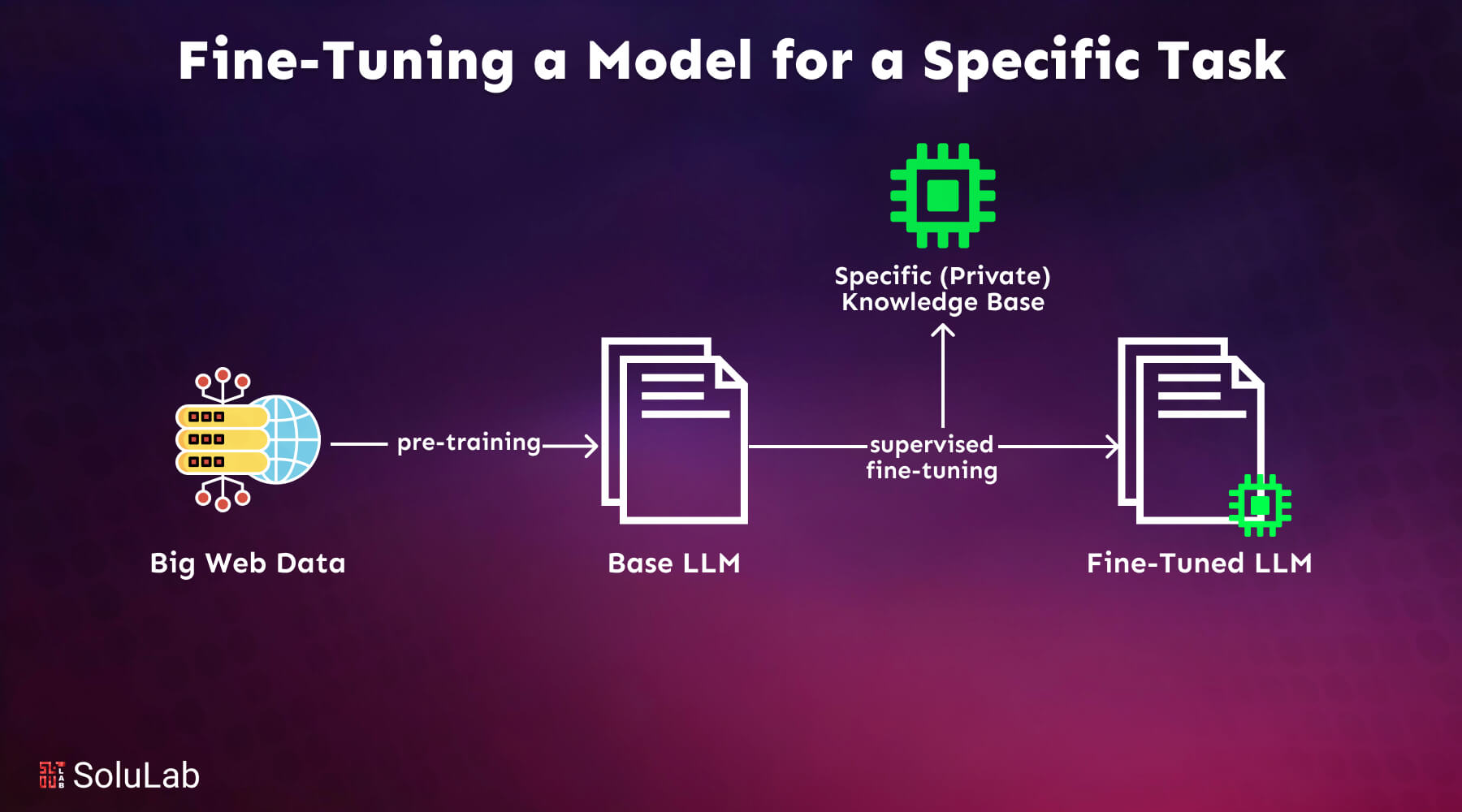
So what is fine-tuning actually doing? It takes a pre-trained LLM and adapts it to a specialized job, say something in blockchain technology. You train the model on a smaller dataset built around that one task. The result: it gets sharper at the thing you care about, and it keeps the broad language ability it already had. A Google study, for instance, found that fine-tuning a pre-trained LLM for sentiment analysis lifted its accuracy by 10%.
Here’s what this piece covers. How fine-tuning improves performance, trims training costs, and gives you answers that actually fit the context you’re working in. We’ll also walk through the different techniques and where they show up in real LLM-powered products.
What is Fine-Tuning, and Why do you Need it?
Fine-tuning means taking a model that’s already been trained and teaching it more, this time on a dataset tied to your topic. Most LLMs today are competent across the board. Point them at a narrow, task-heavy situation, though, and they tend to fall short. The upside of fine-tuning is real: you spend far less on compute, and you get to build on a top-tier model instead of raising one from scratch.
Transformers open the door to an enormous library of models already trained for all sorts of jobs. Pair that with blockchain trade finance applications and the models get more capable still. Fine-tuning is the step that makes them genuinely good at a specific job, whether that’s reading sentiment, answering questions, or boiling a document down to its point.
The tuning reshapes the model so it performs on the task you actually have in front of you. That’s what makes it useful out in the field instead of just impressive on a benchmark. If you want an existing model to fit a particular job or domain, this is the step that gets you there. Whether it’s worth doing depends on your goals, and those shift with the domain and the task at hand.
While it’s being tuned, the model sees example after task-specific example, and it starts to pick up the small distinctions that define the subject. That’s the shift, from a general-purpose tool to a specialist that pulls its weight on targeted work. A few reasons teams reach for it:
a. Customization for Specific Domains
Every domain has its own vocabulary, its own way of phrasing things, its own quiet conventions. Fine-tune a pre-trained LLM and it learns those specifics, then produces content that reads like it belongs in your field.
You get answers that are accurate and on point for what you asked. Legal documents, medical reports, business analytics, or your own internal company data, the tuned model speaks that language and hands back insights specific to it.
b. Ensuring Data Compliance
Some fields run on strict rules. blockchain use cases, healthcare, banking, law, all of them tightly govern how sensitive information gets used and handled. Fine-tuning an LLM on private or controlled data is one way organizations stay inside those regulations.
You build the model on in-house or industry-specific datasets, and the risk of sensitive information leaking out to external systems drops.
c. Overcoming Limited Labeled Data
Getting enough labeled data for a specific task is often hard and expensive. This is where fine-tuning earns its keep: it lets a business squeeze real value out of the labeled data it already has by adapting a pre-trained LLM to that data.
The model performs better and works harder, even when labeled examples are thin on the ground. Tune with a limited set and organizations still see meaningful gains in accuracy and relevance for the task or domain they’re after.

Primary Fine-Tuning Approaches
When you fine-tune a Large Language Model for a blockchain consulting company, you’re adjusting its parameters around the task you want done. How much you adjust depends on what the job demands. Broadly, two approaches cover most of it: feature extraction and full fine-tuning. Here’s how each one works.
Feature Extraction (repurposing)
Feature extraction, sometimes called recycling, is one of the main ways to sharpen an LLM. You treat the pre-trained model as a fixed feature extractor. It has already chewed through a massive dataset, so it carries rich language representations you can put to work on your own task.
Here, you only train the last few layers on task-specific data. Everything else stays put. The model’s existing representations get bent to fit the new job. It’s fast, it’s cheap, and it’s a quick route to a better model for a specific purpose.
Full Fine-Tuning
Full fine-tuning is the other route. Unlike feature extraction, it trains the whole model on task-specific data. Every layer gets adjusted as training runs.
It pays off most when your task-specific dataset is large and looks quite different from what the model saw during pre-training. Let the entire model learn from that data and it becomes deeply shaped around the new task, which can mean stronger results. The catch: full fine-tuning eats more time and more compute than feature extraction does.
Fine-Tuning Process and Best Practices
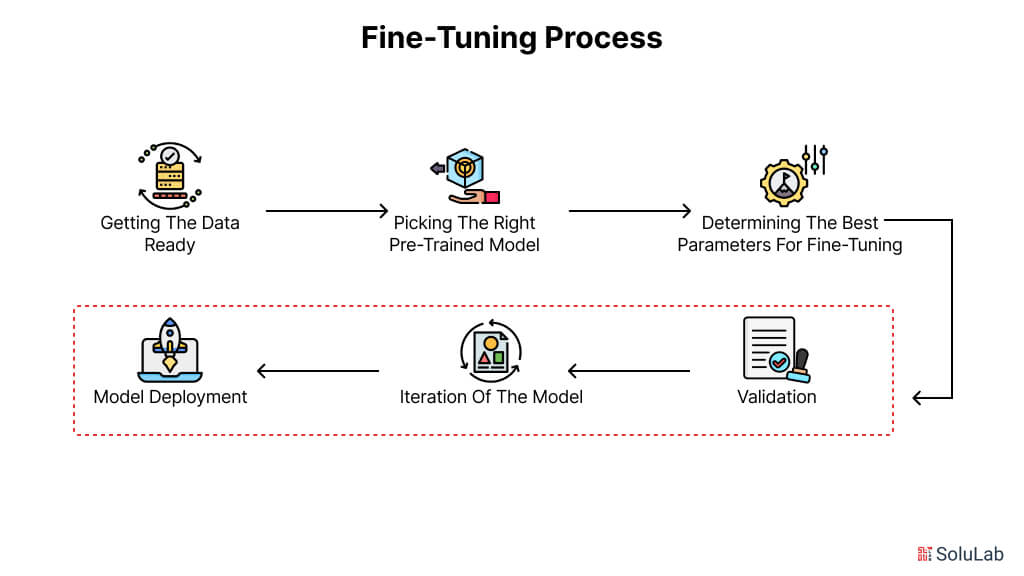
Good fine-tuning follows a clear process. Skip the process and you tend to get muddy results. A few practices worth holding to:
1. Getting the Data Ready
This is the part where you pick your dataset and clean it up so it’s actually useful for the task. Cleaning the data, dealing with missing values, formatting the text so it matches what the model expects on input, it all lives here.
You can also lean on data augmentation to grow the training set and make the model steadier. Don’t shortcut this. Data prep feeds straight into how well the model learns and generalizes, which is to say it decides how good your task-specific outputs turn out.
2. Picking the Right Pre-trained Model
Pick a base model that actually suits your target task or area. To fold it cleanly into the tuning workflow, you’ll want to know its architecture, its input and output specs, and how its layers are laid out.
Weigh things like model size, what it was trained on, and how it has done on related tasks. Choose one whose profile lines up with your task and you’ll speed the tuning along and get a model that adapts better to the job you have in mind.
3. Determining the Best Parameters for Fine-tuning
Your parameter choices make or break the run. Learning rate, number of epochs, batch size, each one shapes how the model takes to your task-specific data. And overfitting? You can often hold it back by freezing some layers, usually the earlier ones, while you train the final ones.
Freeze those initial layers and the model hangs onto the broad knowledge it picked up during pre-training, which frees the final layers to specialize on the new task. It’s a balance: keep what the model already knows, and still learn the task-specific features that matter.
4. Validation
Validation is where you run the tuned model against a validation set and see what you’ve got. Accuracy, loss, precision, recall, these numbers tell you how it performs and whether it generalizes.
Read those metrics closely and you learn how well the model handles task-specific data, and where it’s still weak. That reading is what guides the next round of parameter and architecture tweaks, until you land on a model that returns accurate results for what you built it to do.
5. Iteration of the Model
Iteration is where the test results feed back in. Once you’ve seen how the model performed, you go back and change things: the learning rate, the batch size, how much layer freezing you did.
You can also try adding regularization or reshaping the architecture to keep pushing performance up. This loop is the whole point. Engineers tune step by step, making small improvements again and again, until the model hits the mark they set for it.
6. Model Deployment
Deployment is the step that moves your tuned model into its real home and closes the gap between development and actual use. You have to think about the hardware and software the deployment environment needs, and how the model plugs into the other systems and applications around it.
A smooth, reliable rollout also means sorting out scalability, real-time performance, and security. Get the model into the right environment and its sharpened abilities finally go to work on the real problems you meant them for.
Fine-Tuning Applications
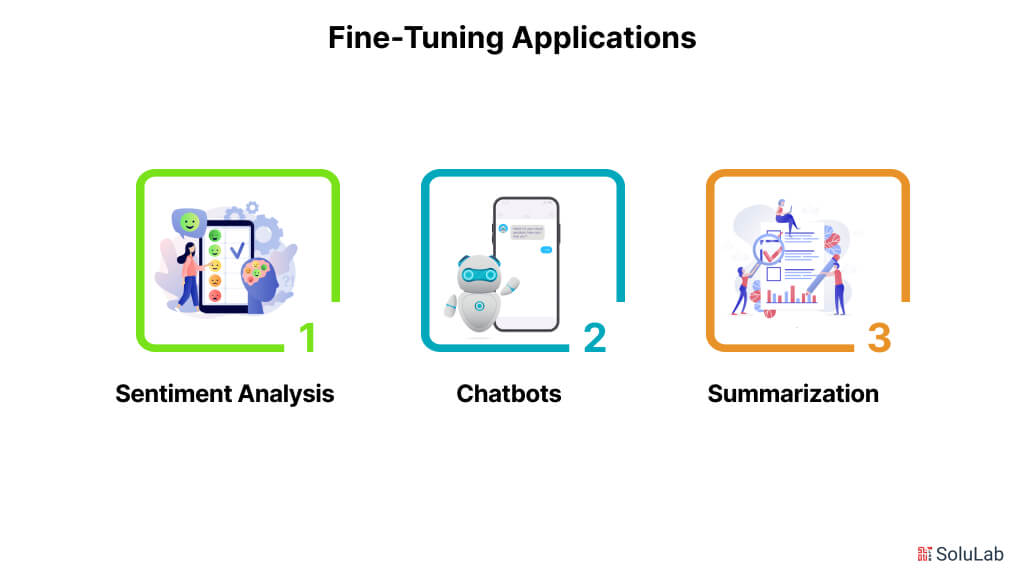
You can tap blockchain platforms to put big models to work on specific tasks without training one from the ground up, just by tuning models that already exist. A handful of places where fine-tuning an LLM tends to really pay off:
1. Sentiment Analysis: Tune a model on your own company data, a niche domain, or a particular task, and it reads emotion in text far more accurately. That’s how businesses pull real meaning out of product reviews, social posts, and customer feedback. Those readings then feed decisions, shape marketing, and point toward new products.
Take an example. A business can use sentiment analysis to spot trends, gauge how satisfied customers are, and find room to grow. Tuned on social media, a model lets a company track how the public feels about its brand, products, or services, so it can get ahead of reputation issues and reach customers in a more targeted way. Put simply, fine-tuned large language models are a serious tool for sentiment analysis, handing businesses a deep read on how customers feel.
2. Chatbots: Tune a chatbot and its conversations get more useful and more engaging, shaped to the context it’s working in. That lifts customer interactions across the board, in support, healthcare, e-commerce, and finance. A tuned chatbot can walk a user through a medical query with detailed, accurate answers, which means better patient care and easier access to information.
Tuned chatbots field product questions, suggest items around what a user likes, and move transactions along. In finance, they hand out personalized advice, help with account management, and answer inquiries accurately and fast. The common thread: tuning language models for chatbots sharpens how they hold a conversation, and that makes them worth having in almost any industry.
3. Summarization: A tuned model can turn a long document, article, or discussion into a short, useful summary on its own. That’s a real help for anyone doing information retrieval or knowledge management, especially the professionals who wade through mountains of data to find the parts that matter.
Tuned summarization models can compress a dense research paper so scholars catch the key ideas and results faster. In business, they cut long reports, emails, and documents down to size, which makes decisions easier and the material simpler to absorb. The payoff is the same each time: fine-tuned language models make information more reachable and easier to understand, and that’s useful in plenty of domains.
Across all these use cases, tuned models tend to deliver the best results. That range is the whole argument for fine-tuning: it takes an LLM and bends it to solve the specific business problem in front of you.
The Different Types of Fine-tuning
There’s more than one way to run fine-tuning. Which one fits depends on your main focus and what you’re trying to reach.
1. Supervised Fine-tuning: The simplest and most common approach. You train the model on a labeled dataset tied to the goal task, something like text categorization or named entity recognition.
For sentiment analysis, you’d train the model on text samples each tagged with the sentiment they carry.
2. Few-shot Learning: A big labeled dataset isn’t always something you can get. Few-shot learning works around that by dropping a few examples, or shots, of the task right into the input prompt. That’s often enough for the model to grasp what you want without heavy tuning.
3. Transfer Learning: Every fine-tuning method is a form of transfer learning, but this one is built specifically to let a model do a job different from the one it originally learned. The idea is simple: take what the model absorbed from a big, general dataset and point it at a narrower, related problem.
4. Domain-specific Fine-tuning: Here the aim is to teach the model to understand and produce content for one particular domain or industry. You tune it on text from that target domain so it gets better at the context and the domain-specific work.
Say you’re building a chatbot for a medical app. You’d train the model on medical records so its grasp of language leans toward healthcare.
Challenges and Limitations
Fine-tuning an LLM for a specific task or body of information is powerful. It also has real drawbacks worth naming.
- Cost and Time: Training big models takes serious compute. For smaller teams, or anyone on a tight budget, that price tag can be a hard stop.
- Brittleness: A tuned model can struggle with new data unless you pay to retrain it. It tends to get frozen into a “stabilized snapshot” of whatever it was trained on.
- Expertise Required: Building and keeping AI systems running calls for specialized skills that aren’t easy to find.
- Quirky Outputs: Models sometimes “visualize” odd or biased results, or lose track of things they’d already learned. Keeping them accurate is a running battle.
So fine-tuning is powerful, but it needs a careful hand. For most teams, the payoff still wins out.
The Challenges of MLOps and LLMOps
Build a production LLMOps pipeline and you get a process you can repeat. You can run it on cloud.zenml.io.
Shipping a tuned model is the start, not the finish. To keep it performing once it’s out there, you’ll run into a whole set of operational headaches in machine learning production:
- Orchestration and Automation: Smoothing out deployment and standing up solid CI/CD pipelines is hard. You’re managing the full lifecycle, training to deployment to monitoring, all of it.
- Infrastructure Complexity: Running the infrastructure behind a deployed model isn’t simple. Think secret management, caching model checkpoints, and tuning hardware and software for inference.
- Performance and Reliability: Once it’s live, your model has to hold up. That means watching throughput, latency, and error rates, and keeping proper versioning so updates don’t break things.
- Monitoring and Debugging: When a deployed model goes sideways, finding out why is tough. You need real tooling to track performance, dig into errors, and catch the failures you didn’t see coming.
- Continuous Improvement: Top blockchain platforms for performance models are never “finished.” They have to keep moving with new data. Setting up a continuous improvement loop is hard, and the tools we have today don’t make it much easier.
Fine-tuning vs. RAG
RAG blends retrieval-based and generative models into one system. The retriever goes looking through a big database or knowledge base for information that matches your query. Then a generative model takes that information and builds a more accurate, more contextual answer on top of it. What RAG brings to the table:
| Parameter | Fine-Tuning | RAG (Retrieval-Augmented Generation) |
| Definition | Fine-tuning involves adjusting a pre-trained model’s weights using domain-specific data. | RAG (Retrieval-Augmented Generation) combines a language model with an external knowledge retrieval system to generate responses. |
| Objective | To adapt the model for improved performance on a specific task or dataset. | To provide real-time, knowledge-rich responses without modifying the base model. |
| Data Dependency | Requires a large, high-quality labeled dataset relevant to the specific task. | Relies on an external knowledge source or database for retrieval. |
| Knowledge Updates | Requires pre-training or additional fine-tuning to update the model’s knowledge. | Updates are as simple as refreshing or updating the knowledge database. |
| Ethical and Privacy Issues | May inadvertently memorize sensitive data, posing privacy concerns. | Privacy risks depend on the external data source but can be mitigated by controlling the database. |
| Computational Resources | High computational cost due to re-training the model. | Relatively lower computational cost since the base model remains unchanged. |
Fine-tuning vs. RAG factors to consider
Choosing between fine-tuning and RAG comes down to a few things:
- Domain-specific applications: Fine-tuning usually wins for highly specialized models. RAG is stronger at pulling in real-time information and outside knowledge.
- Data Availability: Fine-tuning wants a pile of task-specific labeled data. RAG can lean on external data when you simply don’t have that.
- Resource Constraints: RAG uses databases to back up the generative model, which cuts down on training. Fine-tuning, by contrast, asks a lot of your compute.

Conclusion
Fine-tuning large language models opens up a lot of ground for AI applications. More and more companies are tuning LLMs for their own use cases, shaping pre-trained models around what their business actually needs. Done well, it lifts model performance and does it at a reasonable cost. But it isn’t automatic. You need a real grasp of model architecture, of the benchmarks that matter, and of how far the model can be pushed to adapt.
Follow the right practices, take the right precautions, and you can bend these models to your needs and get the most out of them. Want to go deeper? I’d point you to DataCamp’s LLM Concepts course, which walks through the core training methods and the newer research.
Solulab helped NovaPay Nexus build a self-hosted, automated cryptocurrency payment processor, so businesses can take digital currencies with no fees and no middlemen. Users manage multiple stores, spin up payment apps, and run secure transactions with privacy-first features baked in. Solulab, a LLM development company, has a team of experts on hand to work through your business questions. Reach out today.
FAQs
Shipra Garg is a tech-focused content strategist and copywriter specializing in Web3, blockchain, and artificial intelligence. She has worked with startups and enterprise teams to craft high-conversion content that bridges deep tech with business impact. Her work translates complex innovations into clear, credible, and engaging narratives that drive growth and build trust in emerging tech markets.