Key Takeaways
- You can stand up a token on Solana fast, and you pay almost nothing per transaction to do it.
- Once the token exists, it can run payments, DeFi rails, in-game economies, or fractional ownership of real-world assets.
- Bring in a Solana token development team when you need the hard parts wired up: Solana Pay, oracles, liquidity protocols, and an architecture that scales.
Building a crypto token used to eat months and demand real blockchain chops. Not anymore. Solana changed the math. Teams now ship tokens in an afternoon, pay pennies in fees, and lean on a network that rarely blinks under load.
A few numbers explain why people keep picking it:
- 65,000+ theoretical transactions per second (TPS) capacity
- 400 to 800+ real TPS on an average day of normal network usage
- Less than $0.01 transaction fees in most cases
- Hundreds of active dApps across DeFi, NFTs, and gaming
- Millions of daily transactions, often exceeding Ethereum and Polygon combined
Solana has also turned into a serious home for tokenization and digital asset infrastructure.
What is Solana and Why It Is Ideal for Token Creation?
A token on Solana is a digital asset built on the SPL Token standard. If you know ERC-20 tokens on Ethereum, you already know the shape of it.
What can that token stand for? Plenty:
- Utility tokens used within applications
- Governance tokens for decentralized protocols
- Stablecoins
- Reward tokens for communities
- NFT assets representing ownership of digital items
Tokens are what make decentralized economies on Solana actually run.
Here is where they usually show up:
Payments: Send tokens across the network in an instant, and pay next to nothing to do it.
Governance: Hold the token, get a vote on protocol upgrades or project calls.
Staking and rewards: Projects hand out tokens to people who help keep the network humming.
Solana in DeFi applications: Tokens are the fuel behind lending, borrowing, trading, and liquidity pools.
That speed edge is exactly why so many teams reach for Solana token development rather than fight the congestion on slower chains.
Read more: Tokenized Agentic Payment System
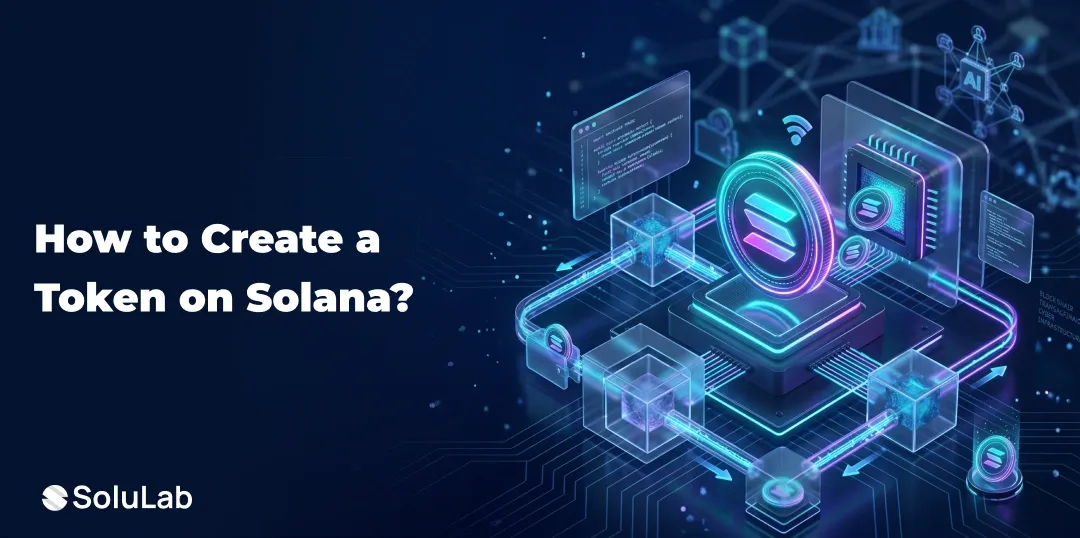
How to Create a Token on Solana in 7 Steps
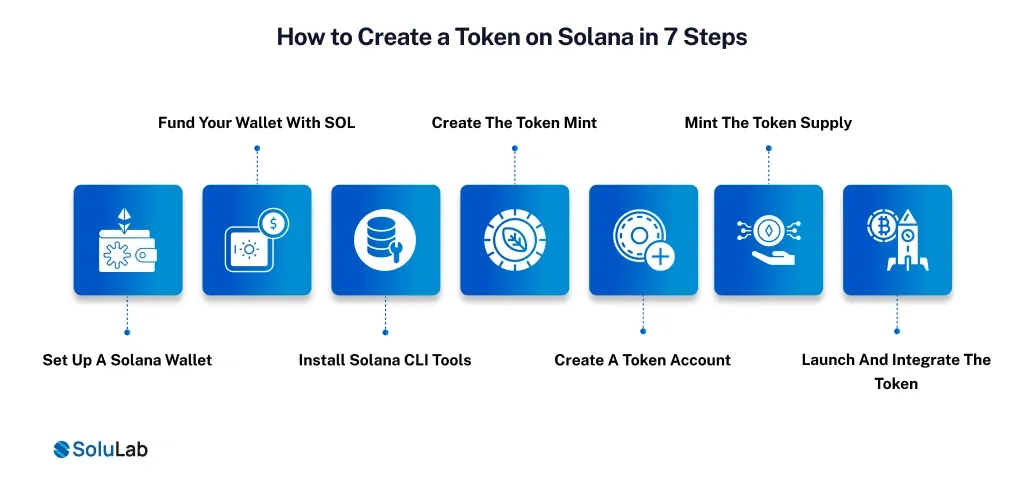
Getting a token live on Solana comes down to a handful of clear moves through the SPL token program. Here they are.
Step 1: Set Up a Solana Wallet
Start with a wallet. Before you can create Solana token assets, you need one that plays nice with Solana.
The usual picks:
- Phantom
- Solflare
- Sollet
Any of these lets you hold assets, talk to applications, and keep your tokens somewhere safe.
Step 2: Fund Your Wallet With SOL
You will need a bit of SOL on hand to pay network fees while you create and manage the token.
How much? Barely any. Even a large token operation usually runs on a few dollars of SOL, because fees here are that cheap.
Step 3: Install Solana CLI Tools
Most developers reach for the Solana command-line interface to talk to the network directly.
What you will want installed:
- Solana CLI
- Node.js
- Rust toolchain (optional)
- SPL token CLI utilities
With those in place, you can create Solana token assets straight from the command line.
Step 4: Create the Token Mint
Now build the token contract itself, using the SPL token program.
Example command:
spl-token create-token
That one line spits out a unique token mint address, which is your token’s identity on the chain.
Step 5: Create a Token Account
Mint address in hand, you now need a token account, the place where the tokens will actually sit.
Example command:
spl-token create-account TOKEN_ADDRESS
This is the account that holds your minted supply.
Step 6: Mint the Token Supply
With the account ready, it is time to mint the supply.
Example command:
spl-token mint TOKEN_ADDRESS 1000000
That drops 1 million tokens into the wallet.
And you are not locked in. Decimals, supply caps, distribution rules: all of it is yours to set.
Step 7: Launch and Integrate the Token
Last move: deploy the token and wire it into whatever you are building.
At this stage, most projects:
- list tokens on decentralized exchanges like Raydium
- integrate DeFi utilities
- enable staking or governance
- launch community programs
Once it is live, that same token can anchor a payment system, a gaming platform, or a full DeFi protocol.
How Solana’s “Lightning-Level” Framework Offers New Opportunities to Enterprises for Token Building
Two years ago, people called Solana a fast blockchain. Now it reads more like a financial infrastructure layer that enterprises actually deploy on. Low fees, huge throughput, real integrations: put those together and you get what a lot of analysts have taken to calling “lightning-level blockchain performance”.
For any organization that wants to build a token on Solana, that foundation opens doors that stayed shut on slower chains.
1. Why Solana Is Attracting Enterprise Token Builders
Day to day, Solana handles millions of transactions and frequently sits near the top of the global rankings by volume. On paper the architecture can push 65,000 transactions per second. In the real world it usually lands somewhere between 400 and 1000 TPS, depending on what the network is dealing with at the time.
A few design choices make that pace possible:
- Proof of History (PoH) for timestamping transactions
- Parallel smart contract execution through Sealevel
- Highly optimized validator infrastructure
All of that is why a business can build Solana token networks that scale to millions of users without hitting the congestion that used to choke older chains.
2. Enterprise Adoption Driving the Solana Ecosystem
This is not theory anymore. Several big names have already baked Solana into their products and payment flows, and those moves say a lot about how much they trust the network for serious work.
A. Visa Expands Stablecoin Settlement on Solana
Back in 2023, Visa said it was widening its stablecoin settlement program to cover USDC on Solana.
Per Visa’s crypto team, the setup clears near-instantly and costs less than the old payment rails.
Visa’s Head of Crypto put it plainly: the company went with Solana for its “high throughput and low transaction costs, which make it suitable for modern payment infrastructure.”
If you are planning to launch solana token payment systems or stablecoins, a nod like that from a global payments giant does a lot for Solana’s credibility.
B. Stripe Supports USDC Payments on Solana
Stripe joined in too, adding USDC payments over Solana so businesses could take stablecoin transactions from anywhere in the world.
Their pitch: on Solana, merchants get paid in seconds instead of days, which is a night-and-day difference for cross-border payments.
It is a clean example of how a company can build solana token payment systems that run at internet scale.
C. PayPal Stablecoin Expansion to Solana
Then, in 2024, PayPal brought its own stablecoin, PayPal USD (PYUSD), over to Solana.
The reason they gave? Speed and cost. Same story as everyone else.
From PayPal’s blockchain leadership:
“Solana provides the scalability needed to support global payment applications.”
Add it all up and Solana looks less like a bet and more like core infrastructure for digital payments and tokenized financial assets.
Explore our case study: DYNK: Solana NFT Wallet Platform Development
Creating Enterprise-Grade Solana Tokens
In 2026, serious Solana tokenization, real estate especially, gets built on token extensions (Token-2022). The point: you write compliance and business logic straight into the token, instead of bolting it on later.
This is the “Professional Developer” workflow worth putting in front of your leads:
1. The Professional Technology Stack
Don’t point at a website. Point at the architecture. A real firm runs on:
- Anchor Framework: The industry standard for writing secure Solana smart contracts (programs).
- Solana CLI & Rust: For high-performance, custom-built logic.
- Helius or QuickNode RPCs: Dedicated “nodes” so transactions don’t drop during a traffic spike.
- ZK Compression: A 2026 standard that lets you issue millions of real estate fractional tokens for pennies by compressing on-chain state.
| Feature | “Random Site” Method | SoluLab Method |
| Standard | Basic SPL (Old) | Token-2022 (Modern) |
| Compliance | None (Anyone can buy) | Transfer Hooks (KYC Gated) |
| Recovery | Lost keys = Lost asset | Permanent Delegation (Asset Recovery) |
| Fees | One-time creation fee | Programmed Royalty/Tax (Revenue Stream) |
Advanced Integrations to Your Token on Solana
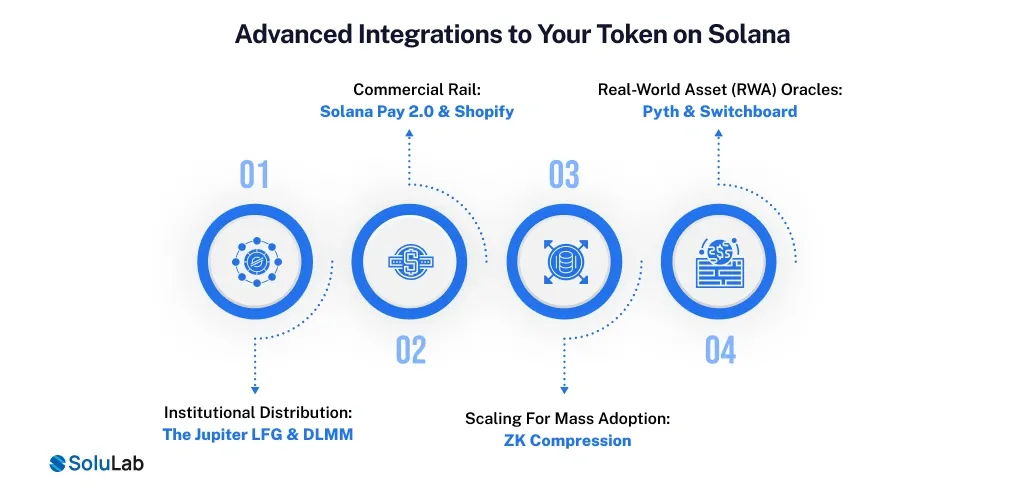
Don’t ship “naked” tokens. For real estate or business use, the native extensions are the whole point:
1. Institutional Distribution: The Jupiter LFG & DLMM
Forget plain “Listing.” What you actually want is to plug into Jupiter, the brain of liquidity on Solana:
- DLMM (Dynamic Liquidity Market Maker): Instead of a static pool, you integrate with Jupiter’s DLMM. Your token gets “infinite depth” at a set price, so one big sell doesn’t crater the chart, which investors love to see.
- Jupiter LFG Launchpad: The good projects don’t just “launch”. They tap the LFG DAO for access to over $1B in community liquidity and instant verification on the “Strict List”.
2. Commercial Rail: Solana Pay 2.0 & Shopify
If the client wants a token that is actually useful, people have to be able to spend it.
- Shopify Integration: 2026 brought a big jump in the Solana Pay Shopify Plugin. Wire your token in and merchants can accept it right at checkout, skipping the 3% credit card fees.
- Loyalty Airdrops: Program the token so that when a customer buys a physical product through Shopify, a “loyalty NFT” or “reward token” mints on the spot and lands in their wallet.
3. Scaling for Mass Adoption: ZK Compression
This is the killer feature of 2026.
- The Problem: Holding data for 1,000,000 token holders on Solana used to run up a real bill.
- The Integration: With ZK Compression, your firm can help a company issue millions of fractional real estate tokens for 90% less than standard tokens cost. You are squeezing the blockchain data down into a tiny proof, and that alone makes mass-scale asset issuance workable for the first time.
4. Real-World Asset (RWA) Oracles: Pyth & Switchboard
For real estate tokenization, the token price shouldn’t drift on pure market mood. It should track what the property is really worth.
Oracle Integration: Wire in Pyth Network or Switchboard to feed real appraisal data (say, from Zillow or a specialized property data source) straight into the token’s smart contract. That keeps the token’s “Price Floor” tied to the physical asset instead of floating loose.
Read more: Tokenization for boutique investment banks
How Much Does it Cost to Create Tokens on Solana?
Launching a token on Solana isn’t one bill. It is a chain of steps, and each one carries its own price tag. Here is how the main pieces break down.
| Component | Expense |
| Initial Designing | $1,000-$5,000 |
| Token Design | $2,000-$10,000 |
| Development | $10,000-$50,000 |
| Testing and Auditing | $5,000-$20,000 |
| Deployment | $100-$500 |
| Marketing The Token | $5,000-$50,000 |
| Legal Compliance | $5,000-$20,000 |
| Overall Total Cost | $30,000-$150,000 |
Major Requirements for Creating Solana Token
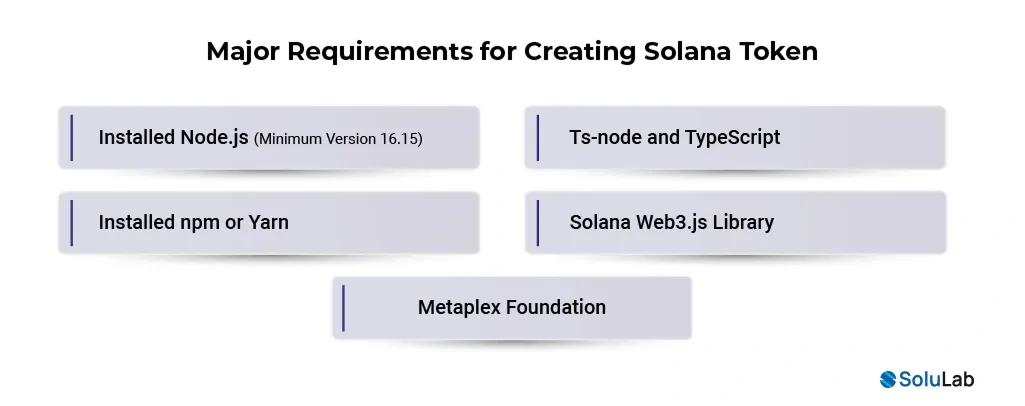
Before you spin up a token on Solana, a handful of tools and setups need to be in place. These are what let you deploy Solana smart contracts, hold up solid infrastructure, and keep the build moving without nasty surprises.
- Installed Node.js (Minimum Version 16.15)
Node.js is what runs your JavaScript-based apps, and it keeps you compatible with the current libraries and frameworks the Solana crowd relies on. Check your version first. You want 16.15 or higher.
- Installing npm or Yarn
You need a package manager (npm or Yarn) to pull in dependencies and get the project off the ground. Pick whichever one you like. Solana’s tooling backs both of them just fine.
- Ts-node and TypeScript
TypeScript makes the code easier to write and maintain, and that matters a lot once you are deep in Solana’s libraries. The ts-node package saves you time by running TypeScript files directly, so there is no manual compile step to babysit.
- Solana Web3.js Library
The Solana Web3.js module hands you the core hooks you need to talk to the chain. With it, developers can call on-chain programs, sign transactions, and create accounts.
- Metaplex Foundation
Want richer features, like plug-ins or proper token metadata? That is where the MPL Token Metadata library and the default Metaplex Foundation plug-in bundle come in. They keep your tokens lined up with Solana’s standards.
Get these tools and resources sorted, and you have the base for a scalable, reliable token on Solana.
Read more: Top RWA Tokenization Questions Answered for Enterprises Ask in 2026
How to Promote The Token?
On the top blockchain platforms, shipping the token is only the start. To pull in users, developers, and investors, you need an actual marketing plan. Good promotion is what builds a community, earns trust, and gets people to adopt the thing. Here are a few tactics worth leaning on to get your Solana token noticed.
1. Marketing on Social Media
Social media is where the blockchain crowd actually hangs out, so meet them there. Use Twitter for milestones, teaching content, and quick updates. Use Discord for the deeper stuff: long conversations, answering questions, and building buzz. That is where you grow a real community and talk to users and investors in real time. And don’t skip the crypto forums or the wider Solana community, because showing up there lifts your visibility too.
2. Partnerships and Cooperation
Teaming up with other projects across Solana can push your coin in front of a lot more people. Reach out to DeFi platforms, NFT marketplaces, or decentralized apps and work your token into what they already offer. Joint events, cross-promotions, and shared incentives are all ways to land in front of audiences you would never reach on your own.
3. Incentive Plans
Incentives work. They always have. Airdrop free tokens to early adopters or a target group, and you spark interest while quietly growing your holder base. Staking does something different: lock tokens up, hand out rewards, and you give people passive income while nudging them to hold long term, which eases sell pressure. Referral schemes and other rewards pull in the rest.
Stack these tactics together and you can market your Solana coin well, build a community with real energy, and give your project a genuine shot at success in blockchain technology.
Growing With SoluLab and Understanding Solana Blockchain
Launching your own token on Solana is one of the smarter ways to put Blockchain-as-a-Service to work for the business. Fast network, tiny fees, room to scale: it gives you a solid base for blockchain products that can hold their own as the digital economy keeps shifting.
At SoluLab, our 250+ blockchain experts help businesses build Solana-based solutions worth shipping: NFT-powered ownership systems, cryptocurrency wallets, digital asset management platforms, and custom blockchain applications.
- Our portfolio spans digital asset management and Web3 across a range of builds, including our work with DYNK.
- We helped DYNK build a Solana-based platform where NFTs act as ownership keys for fully working cryptocurrency wallets, which reshapes how users hold and move their digital assets.
- That meant standing up secure wallet infrastructure, the NFT-as-ownership mechanism, tight Solana integration, and an architecture that scales while staying secure, fast, and easy to actually use.
Ready to build your own Solana token and open up new business ground? Contact SoluLab today and let’s turn the idea into something real.
FAQs
Shipra Garg is a tech-focused content strategist and copywriter specializing in Web3, blockchain, and artificial intelligence. She has worked with startups and enterprise teams to craft high-conversion content that bridges deep tech with business impact. Her work translates complex innovations into clear, credible, and engaging narratives that drive growth and build trust in emerging tech markets.