
Key Takeaways
- ICO platforms in 2026 are built around compliance, liquidity depth, and long-term investor trust.
- Features like ZK-KYC, ERC-3643, and cross-chain access now directly impact launch success.
- Institutional-grade launchpads help reduce legal risks, onboarding friction, and post-launch volatility.
- A strong ICO strategy today focuses on ecosystem growth, not just fundraising momentum.
The initial coin offering market in 2026 feels very different from the frenzy that defined earlier cycles. One reason is that tokenized asset launches are projected to cross $22.8 billion in annual volume. This shift is pushing ICO platform development and token launch services closer to digital capital markets rather than retail crowdfunding.
Now, the focus is on choosing the right ICO development solution that can support long-term liquidity, meet compliance standards across regions, and make onboarding smooth enough that users do not drop off before investing.
- That shift matters because token launches now sit at the intersection of product, finance, and regulation.
- A weak launch setup can create delays, legal issues, liquidity gaps, and trust problems that are hard to fix later.
A strong or top ICO platform, on the other hand, works like a well-built runway. It helps projects take off 90% smoothly and keeps them 100% stable after lift-off.
Why Do ICO Platforms in 2026 Look More Like Financial Infrastructure Than Fundraising Pages?
In practical terms, Initial Coin Offerings (ICOs) mean launchpads now need to support more than token sales. They must handle identity checks, jurisdiction-based restrictions, treasury logic, liquidity provisioning, tax reporting, and post-launch governance.
Think of them less like online storefronts and more like airport control towers coordinating multiple moving parts at once.
1. Compliance Is Now Part of the Product
A few years ago, compliance often sat outside the product experience. Users uploaded documents manually, teams handled approvals through support tickets, and reporting was fragmented. That approach no longer works.
In 2026:
- MiCA enforcement in Europe has made automated KYC and AML processes essential.
- Global travel rule reporting has pushed platforms toward real-time monitoring.
- Accredited investor verification has become standard for higher-value launches.
- Additionally, compliance-first STOs have shown nearly 40% higher institutional retention in Q1 2026 than unregulated utility launches.
Modern ICO platform development now treats compliance as a built-in workflow rather than a last-minute add-on.
2. Smart Contracts Need Legal Logic, Not Just Token Logic
The old ERC-20 approach is no longer enough for serious launches.
Today, trusted ICO platforms support:
- ERC-3643 (T-REX) includes an embedded identityRegistry, allowing issuers to whitelist wallets, enforce jurisdiction controls, and trigger real-time clawbacks if a wallet is compromised or flagged.
- Solana Token Extensions now support transfer hooks, confidential transfers, and programmable restrictions for higher-speed compliant launches.
- Account abstraction (ERC-4337) has reduced wallet friction by allowing users to pay gas in the token they are buying, improving conversion at the final purchase step.
This matters because token contracts are now expected to reflect legal and operational rules from day one.
3. Privacy and UX Need to Work Together
Users want faster onboarding, but they also expect privacy.
That is why zero-knowledge verification has become more relevant in 2026. ZK-KYC integrations across leading launchpads have reduced manual onboarding and KYC review time by nearly 90%, especially for accredited investor flows.
Instead of forcing investors to share sensitive identity documents with every project, ZK systems can confirm:
- accredited investor status
- country eligibility
- KYC approval
This lowers data risk while improving trust among the users. This is what modern ICO platform development solutions mean.

What Should Businesses Evaluate Before Picking an ICO Platform in 2026?
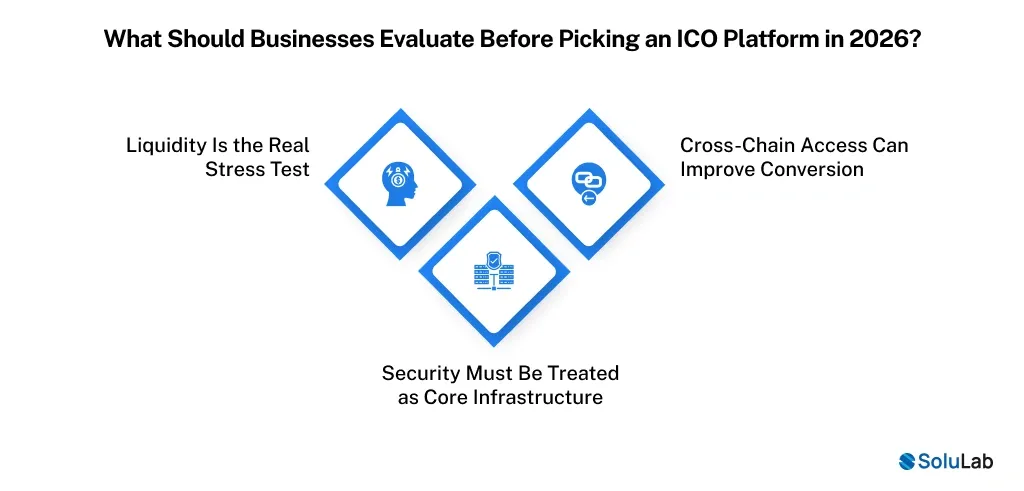
Choosing an ICO platform on blockchain technology today is like laying the foundation for a skyscraper. If the structure underneath is weak, growth only increases the risk.
An ICO platform should be judged by how well it supports scale after the token sale, not just how quickly it can collect funds.
1. Liquidity Is the Real Stress Test
A successful ICO platform development is not solely defined by subscriptions. It is defined by what happens when the token starts trading.
Projects should look for:
- protocol-owned liquidity support
- AMM integrations
- exchange listing pathways
- post-launch price stability tools
Without liquidity depth, even a strong launch can face sharp sell-offs in the first 24 to 72 hours.
2. Security Must Be Treated as Core Infrastructure
In 2026, security cannot be a checkbox.
Look for trusted ICO platforms that offer:
- audited smart contracts
- MPC custody support
- wallet security layers
- anti-DDoS protection
- server hardening
The goal is not just to prevent attacks. It is to build investor confidence before the ICO platform services launch.
3. Cross-Chain Access Can Improve Conversion
Friction kills momentum.
Top ICO platforms with:
- account abstraction support
- gas abstraction
- cross-chain wallet compatibility
- simple claim flows
can reduce user drop-offs during high-intent moments.
Late 2025 and early 2026 made this especially clear. The projects that reduced wallet friction and gas confusion consistently saw better conversion rates.
Top ICO Platforms Worth Watching in 2026
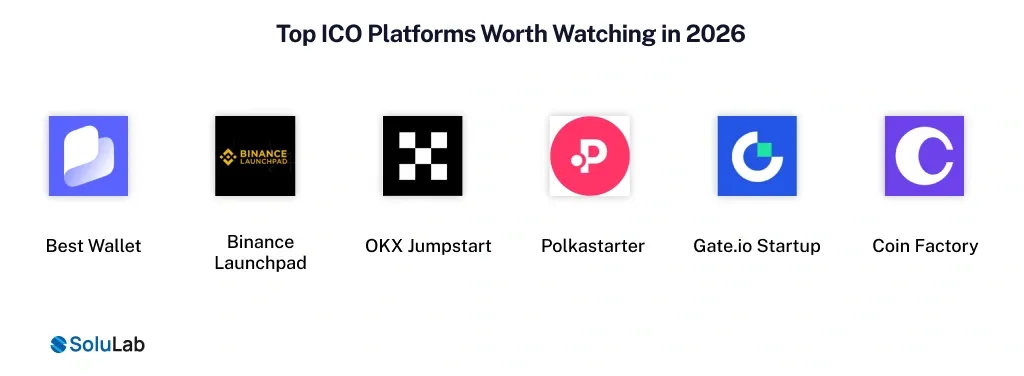
The best ICO platforms in 2026 are not simply the biggest names. They are the ones balancing trust, technical depth, and launch efficiency.
1. Best Wallet
Best Wallet has become one of the most practical launch platforms for users who want flexibility without complexity in ICO development.
Its March 2026 rollout of ZK-KYC was a notable step. It allows users to verify compliance status without exposing full identity details to issuers.
Key strengths:
- mobile-first UX
- support across 20+ blockchains
- smoother wallet management
- easier access for global participants
For projects targeting wider user participation, this reduces onboarding friction significantly.
2. Binance Launchpad
Binance Launchpad remains one of the strongest options for ICO service projects that need deep liquidity and a large user reach.
Between late 2025 and early 2026, Binance became more selective and focused on higher-conviction launches.
Recent strengths include:
- tighter listing standards
- Linea integration to reduce gas friction
- proof-of-liquidity mechanisms for stronger market depth
- access to a massive verified user base
For enterprise-grade launches, Binance still offers one of the strongest takeoff runways.
3. OKX Jumpstart
OKX has strengthened its position by improving launch flexibility for both users and projects.
Its 2026 shift toward compliance-led staking and tokenized collateral models is especially relevant for institutional users.
Highlights:
- staking-based launch participation
- cleaner participation flow
- better visibility into launch progress
- evolving treasury-backed participation models
This makes OKX attractive for projects looking beyond short-term hype.
4. Polkastarter
Polkastarter has moved beyond standard IDOs by making launch access smarter.
Its AI-powered PolkaTrader and newer monitoring systems help reduce the post-launch volatility that often hurts retail users.
Key benefits:
- cross-chain pools
- anti-bot tools
- AI-led trading insights
- stronger community alignment
It works well for Web3-native projects that want deeper DeFi engagement.
5. Gate.io Startup
Gate.io continues to be a useful platform for early-stage projects.
Its biggest strength remains structured launch access and project vetting.
What stands out:
- clear project metrics
- easier airdrop access
- straightforward participation
- fast project exposure
For investors looking to discover earlier opportunities, it remains relevant.
6. Coin Factory
Coin Factory stands out as one of the best ICO service providers for businesses that need more than a public token launch.
It is particularly relevant for RWA projects, STOs, and companies entering regulated markets.
Core strengths:
- white-label launchpad development
- integrated KYC and AML modules
- multi-currency support
- anti-DDoS and security layers
- customizable token sale logic
For businesses focused on compliance and long-term ecosystem control, it is one of the most practical options.
Quick table for your ICO platforms model checklist:
| Platform | Best For | 2026 Edge | 2026 Performance Metric |
| Best Wallet | Mobile-first access | ZK-KYC and multi-chain participation | ~90% faster onboarding via ZK verification |
| Binance Launchpad | High-liquidity launches | Proof-of-Liquidity and Linea support | Avg. day-1 liquidity depth often exceeds $25M |
| OKX Jumpstart | Staking-led access | tokenized collateral pathways | Up to 85% LTV via tokenized treasury collateral models |
| Polkastarter | DeFi-native launches | AI trading and volatility monitoring | AI monitoring reduces early dump risk |
| Gate.io Startup | Early-stage discovery | vetted launch structure | Faster listing exposure for seed-stage projects |
| Coin Factory | Enterprise tokenization | compliance-first white-label builds | 35–40% lower back-office overhead via automation |
How Can the Right ICO Strategy Turn a Launch Into Long-Term Growth?
A token launch should not feel like setting off fireworks for one night. It should work like building a power grid that keeps delivering value over time.
That requires planning beyond fundraising, so that you can gain high ROI.
- Coin Factory-style automated cap table and compliance workflows can reduce back-office overhead by 35–40%.
- RWA-backed token launches are commanding nearly 12% liquidity premium over traditional private placements because of 24/7 secondary trading access.
Let’s see how you can also gain this.
1. Focus on Ecosystem Design, Not Just Token Sale Metrics
Projects that succeed in 2026 think beyond launch day.
They plan for:
- treasury management
- governance structure
- vesting schedules
- community incentives
- exchange readiness
This creates stability and long-term confidence.
2. RWA Tokenization Is Reshaping Launch Value
The biggest growth shift in 2026 is the rise of real-world asset tokenization.
Token launches tied to:
- real estate
- commodities like copper and diamonds
- logistics assets
- yield-bearing instruments
They are attracting stronger institutional attention because they offer clearer utility and cash flow visibility.
How SoluLab Helps Businesses Launch with More Confidence?
Launching an ICO platform in 2026 requires more than code. It requires coordination across product, compliance, wallets, and investor experience.
SoluLab, a top crypto launchpad development company, helps businesses build launch ecosystems that are secure, scalable, and aligned with modern market expectations.
Our support includes:
- smart contract architecture and audits
- wallet integration
- KYC and compliance workflows
- token launch platform development
- post-launch growth support
A strong example is Token World, where SoluLab helped build a secure ICO ecosystem with multi-currency wallet integration.
The project needed a launch setup that could support crypto contributions from different asset types while keeping the experience simple for users. Our team delivered a scalable wallet and ICO infrastructure that improved launch readiness and investor trust.
If you are planning an ICO or tokenization launch, the right platform decision will shape everything that follows, from investor confidence to long-term liquidity and growth. Contact us today to discuss your choices.
FAQs
Deepika is a content writer who blends storytelling with strategic thinking. She explores topics across digital innovation, emerging tech, and the evolving blockchain industry. She enjoys breaking down complex ideas into simple, engaging narratives in the growing global markets.