Generative AI chatbots have grown fast. The global chatbot market was worth around $5.7 billion in 2023 and is projected to expand at a CAGR of 22.3% from 2023 to 2032. That growth is tied directly to better large language models, particularly GPT-4 and PaLM 2, which gave these tools the ability to hold genuinely contextual conversations instead of just pattern-matching keywords.
Adoption has been quick across industries. A recent report found that chatbot usage as a brand communication channel jumped 92% between 2019 and 2020. Only 11% of brands were using chatbots to talk to customers in 2019. By 2020, it was 25%. That kind of jump in one year does not happen without real results behind it.
This post covers the 10 generative AI chatbots that are actually leading the market right now, what makes each one worth your attention, and where they fit best.
Importance of AI Chatbots in Various Industries
The real reason AI chatbots matter is not the technology itself. It is what they let teams stop doing. In customer service, companies can answer customer questions at 2 AM on a Sunday without paying anyone to sit at a desk. Response times drop. Agents handle fewer repetitive tickets. The routine stuff, FAQs, order status checks, common troubleshooting, gets handled without anyone having to think about it.
In e-commerce, chatbots guide shoppers through product decisions, suggest alternatives, and nudge people through checkout. Cart abandonment is a real cost, and a well-timed chatbot prompt can recover some of it. Healthcare is a different story, but the pattern holds: appointment booking, triage questions, mental health check-ins, these interactions scale better with AI than with humans alone. The banking and finance sectors use chatbots to handle the high volume of standard banking queries and keep communication auditable and secure.
In education, chatbots field course questions, suggest reading paths, and handle admin requests that would otherwise pile up in a support inbox. The underlying logic is the same everywhere: free up human attention for the things that actually need it.
What is a Generative AI Chatbot?
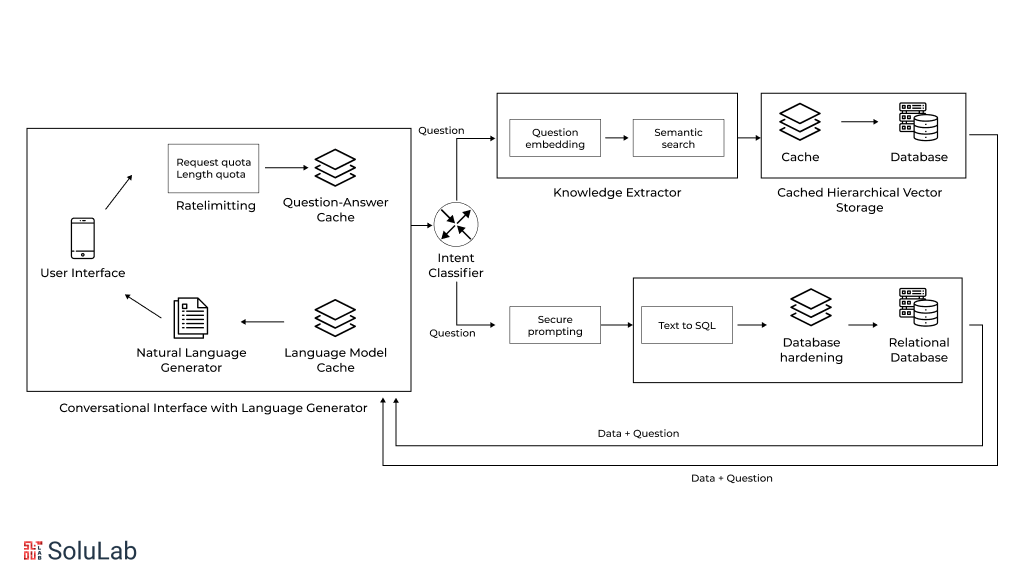
A generative AI chatbot generates responses on the fly rather than selecting from a fixed list of canned replies. That distinction matters more than it sounds. Traditional rule-based chatbots follow a decision tree. They work until the user says something unexpected, then they break. Generative chatbots use large language models (LLMs) to read the input, understand intent in context, and write a response from scratch. This means they can handle questions their builders never anticipated.
What separates top generative AI chatbots from the rest is how well they hold context across a conversation. They adapt tone, track what was said earlier, and give answers that feel relevant rather than canned. A rule-based bot that hits an edge case gives you a dead end. A generative one tries to work through it.
The backbone of these tools is LLMs like GPT-4, PaLM 2, or LLaMA. These models train on enormous text datasets, and that training is what lets the best generative AI chatbots in 2026 pick up on nuance, match register, and produce responses that read like a person wrote them. The gap between old-school bots and modern LLM-powered chatbots is not incremental. It is categorical.
Related: Customer Service Automation
Key Features of Generative AI Chatbot
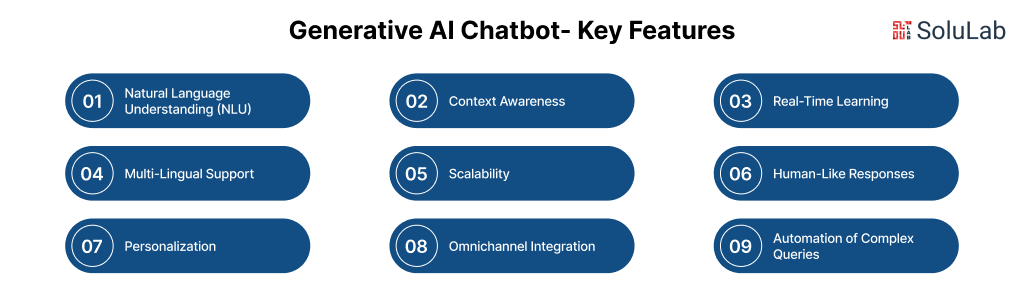
Not all AI chatbots are built the same. Generative AI-powered tools stand out because of what happens under the hood, and the differences show up in real conversations. Here is what actually matters:
Below are some key features that set Generative AI-powered chatbots apart:
Natural Language Understanding (NLU)
These chatbots do not just scan for keywords. They parse what the user actually means, accounting for phrasing, context, and intent. The result is responses that feel relevant rather than technically correct but practically useless.
Context Awareness
The chatbot remembers what was said three messages ago and uses that to shape its next reply. This is where most rule-based systems fall apart. Generative models carry context across the conversation instead of treating every message as a fresh start.
Real-Time Learning
Each interaction is a data point. Over time, the chatbot gets sharper on the specific queries and patterns it sees most often. This compounds. A chatbot that has handled thousands of real customer conversations is a different tool than one fresh out of setup.
Multi-Lingual Support
A user in Germany and a user in Brazil can both get useful answers in their own language without separate configurations for each market. For any business with a global user base, this is not optional. It is the baseline expectation.
Scalability
Running five conversations simultaneously or five thousand simultaneously is the same operational cost. That is not true for human support teams. Businesses with large or seasonal customer volumes notice this difference fast.
Human-Like Responses
By drawing on large language models, these chatbots produce replies that read naturally. Tone varies appropriately, phrasing adjusts to the situation, and the conversation does not feel like filling out a form. That matters for user experience more than most teams anticipate.
Personalization
The chatbot shapes its responses based on who is asking. Past interactions, stated preferences, behavioral patterns, these all feed into what gets said next. A returning customer should get a different experience than a first-time visitor, and good generative AI tools make that distinction without manual rules for every scenario.
Omnichannel Integration
The same chatbot works across your website, your messaging apps, and your CRM. Customers get a consistent experience no matter where they reach out. And your team sees the full conversation history in one place rather than scattered across platforms.
Automation of Complex Queries
Generative AI chatbots go beyond basic FAQ handling. Multi-step requests, ambiguous questions, queries that require pulling from several knowledge sources, these no longer need a human in the loop. That directly reduces ticket volume and shortens resolution time.
Criteria for Choosing the Top Generative AI Chatbots
Picking the right one from a crowded market is harder than it looks. Every vendor claims to have the best generative AI chatbots. The useful question is: best at what, for whom? Here are the criteria that actually separate good choices from bad ones when evaluating top generative AI chatbots:
Accuracy and Language Understanding
If the chatbot misunderstands the question, nothing else matters. The top priority is language model quality. That means strong context retention, low hallucination rates, and accurate interpretation of varied user phrasing. Test it with your actual queries before committing.
Customization and Flexibility
You will need to adapt the chatbot to your workflows, your tone, and your specific use cases. The top generative AI chatbots give you real control over conversation flows, response styles, and behavior in edge cases. A chatbot you cannot configure is a chatbot you cannot trust.
Integration Capabilities
A chatbot that lives in isolation is only half useful. Look for tools that connect cleanly to CRM systems, your website, your messaging channels, and your support stack. The easier the integration, the faster you get to actual value rather than months of technical setup.
Natural and Conversational Flow
Users notice quickly when a chatbot feels robotic. The best tools maintain a natural back-and-forth, match the conversational register of the user, and do not produce responses that read like they were pulled from a template. This is not a nice-to-have. It directly affects whether users actually complete their interaction or give up.
Scalability
What works at 1,000 conversations per month needs to still work at 100,000. Check how the platform handles load spikes. Response time degradation under volume is a real problem, and one that rarely shows up in demos.
Security and Data Privacy
This one is non-negotiable for regulated industries. Check for GDPR compliance, data residency options, and clear policies on whether your conversation data gets used for model training. In healthcare, finance, or legal contexts, getting this wrong is not a recoverable mistake.
Cost-Effectiveness
Upfront pricing rarely tells the full story. Factor in conversation volume costs, API call limits, support tier differences, and integration fees. A chatbot that looks affordable at low usage can get expensive fast at scale. Model the total cost against the support hours you expect to reduce, and make sure the math actually works.
Evaluate against all of these before signing anything. The top generative AI chatbots will hold up across every criterion. Weaker options tend to have one or two strengths and several gaps that only appear after deployment.
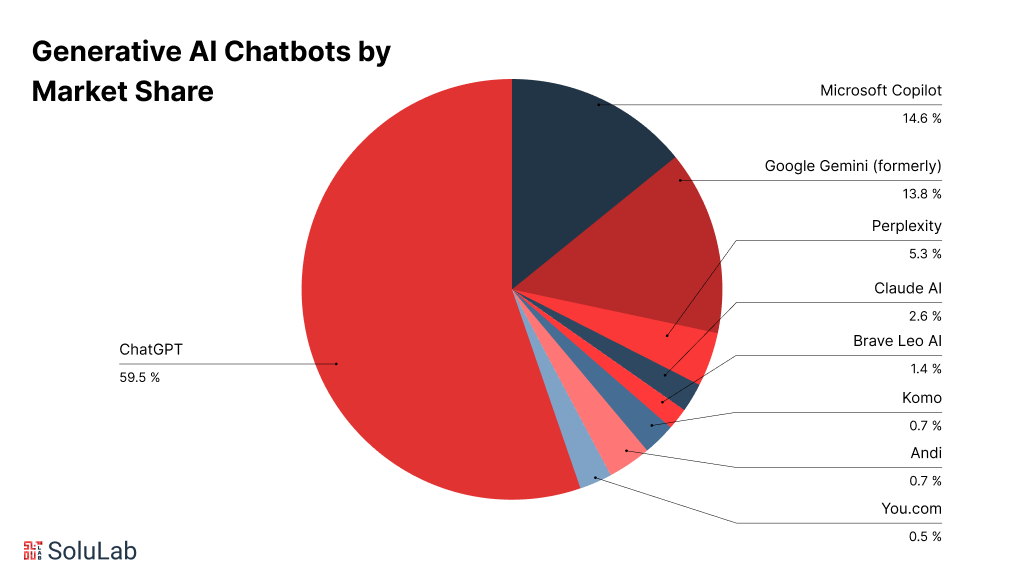
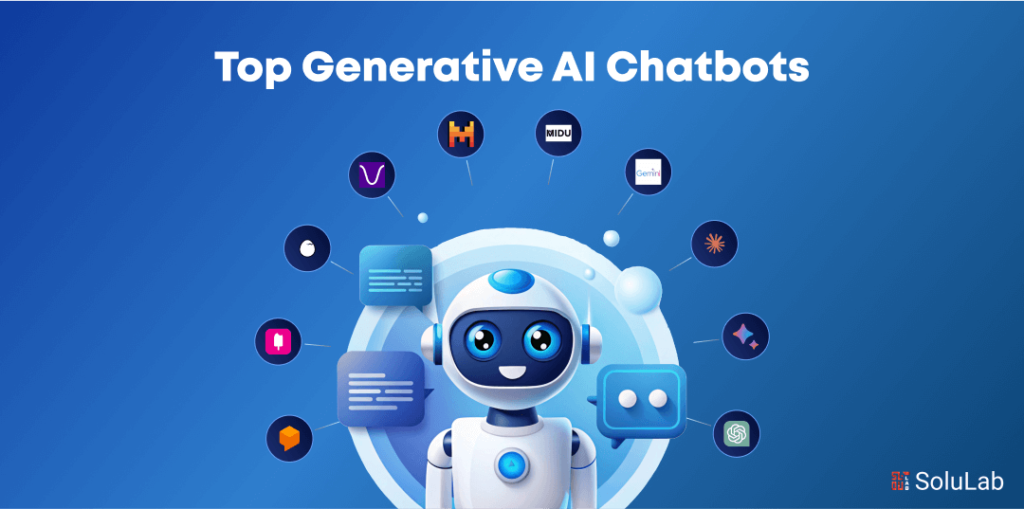
Interested? Here are the top 10 generative AI chatbots in 2026:
1. ChatGPT by OpenAI
ChatGPT is still the name most people reach for when they think of generative AI, and there is a reason for that. Built on GPT-4, it handles an unusually wide range of tasks well, from customer support to code generation to content drafts. What keeps it at the top of the best generative AI chatbots in 2026 list is not just raw capability. It is the combination of strong language quality, solid API access, and the kind of customization flexibility that enterprise deployments actually need. The top generative AI chatbot software crown goes where it earns it, and ChatGPT has earned it consistently.
As a generative AI-powered chatbot, ChatGPT holds conversation threads well. It tracks what was said, adjusts based on how the user engages, and rarely loses the plot mid-conversation. That quality of dialogue, combined with how easily it slots into existing business platforms, is what makes it a go-to for enterprises operating at scale. OpenAI keeps shipping improvements, and the gap between ChatGPT and the field is one of the more closely watched dynamics in chatbot development.
2. Bard by Google
Google’s Bard earns its spot among the best generative AI chatbots in 2026. The access to Google’s underlying language infrastructure shows in response quality, particularly for factual, search-adjacent queries. It is a strong choice for businesses that are already deep in Google’s product stack, since the integration story there is genuinely clean. Deployment across industries is straightforward, and Bard handles complex conversations without falling apart at the edges. For anyone looking at top generative AI chatbot software with Google connectivity as a priority, this is the obvious pick.
Beyond language quality, Bard holds up well on personalization. It adapts to individual users over time, which shows up in customer service contexts where repeat interactions need to feel progressively more relevant rather than starting from scratch each time. The NLP foundation is solid, routine query automation works, and response times stay fast. Good examples of what generative AI chatbots can do at their best.
3. Claude by Anthropic
Claude, from Anthropic, is built with a specific priority in mind: safe, accurate, and honest outputs. It is not trying to be the most impressive chatbot in every category. It is trying to be the most trustworthy. That design goal matters for certain industries more than others, and it shows up in practice. Claude is notably good at avoiding the kind of confident nonsense that other models occasionally produce. If you are deploying a generative AI-powered chatbot in a context where accuracy and ethical alignment matter more than creative output, Claude is hard to beat. It sits comfortably among the top generative AI chatbot software options for teams that cannot afford hallucinations.
As a generative AI chatbot focused on responsible AI usage, Claude integrates well into workflows where data handling must be airtight. Healthcare, finance, legal services: these are the verticals where companies deploy AI chatbots and need to know their AI is not going to fabricate a regulation or misquote a policy. Claude is designed specifically for that kind of trust requirement.
4. Gemini by Google DeepMind
Gemini is Google DeepMind’s flagship generative AI-powered chatbot, and it is built for complex, multi-turn interactions. Where some tools lose coherence after a few exchanges, Gemini holds threads across long conversations without much degradation. That makes it particularly well-suited for customer support contexts where issues require extended back-and-forth to resolve rather than a single question-and-answer.
By 2026, Gemini has become one of the best generative AI chatbots for creative and analytical tasks alongside standard support use cases. Businesses already running on Google infrastructure will find the integration story compelling. It is adaptable, it scales without drama, and the language quality is consistently high. A strong all-rounder with genuine flexibility.
5. Midu by Baidu
Baidu’s Midu is a different kind of entry on this list. Built for both English and Chinese-speaking users, it holds a dominant position in Asian markets that Western tools simply cannot replicate. If your customer base includes users in China, Midu is not just a good option, it is likely the right one. Among the best generative AI chatbots in 2026 for regional coverage, it stands apart. The machine learning foundation means it improves with use, and it handles both simple and complex queries without a significant drop-off in quality. A practical choice for any business that needs top generative AI chatbot software with real localization depth.
The multilingual capability is not superficial. Midu handles conversational nuance across languages rather than just translating outputs, which is where a lot of competitors fall short. For global businesses with a significant APAC presence, that distinction is the one that closes the decision.
6. Mistral by Meta
Meta’s Mistral is built around contextual depth and creative language output. It is a generative AI-powered chatbot that reads well in dynamic, fast-moving environments. Social media and e-commerce are the obvious use cases, where conversations are short, informal, and high-volume. Mistral handles the pace and personalization that those contexts demand. Among the best generative AI chatbots in 2026, it is probably the strongest choice specifically for social-facing deployment.
What sets Mistral apart from other top generative AI chatbots is adaptation speed. It picks up on new trends and conversational patterns faster than most, which matters in environments where the way people talk changes week to week. Meta keeps improving it, and the roadmap reflects exactly the kind of large-scale enterprise use cases that make a chatbot worth building around for the long term.
7. Vivoka AI Assistant
Vivoka is a voice-first generative AI chatbot, and that focus shows in how well it handles speech-to-text and natural language understanding in spoken interactions. Most chatbots are designed for text first and add voice as an afterthought. Vivoka is the other way around. For businesses where voice is the primary interface, it is one of the top generative AI chatbot software options in 2026 with real depth in that channel.
The IoT and smart assistant integration is a genuine differentiator. Automotive dashboards, home automation systems, hospitality kiosks: these are contexts where typing is not an option and voice has to work reliably. Vivoka is built for exactly those deployments, connecting generative AI-powered chatbot technology to a set of use cases that most other vendors are still trying to figure out.
8. Replika
Replika is the most unusual entry on this list. It is not a business tool in the traditional sense. It is a generative AI chatbot designed for personal connection, specifically emotional support and companionship. Among the best generative AI chatbots for individual use, it is in its own category. The focus is not on answering queries. It is on building a relationship, learning how a particular user communicates, and being present in a way that most productivity tools have no interest in.
That sounds like a narrow use case until you look at where mental health applications are heading. Replika stands apart from other generative AI chatbot examples by prioritizing emotional intelligence over task completion. In industries where conversational AI can reach people who would not otherwise seek help, that emotional attunement is exactly the right design choice. It is a different kind of AI chatbot, doing a different kind of work.
9. Xiaoice by Microsoft
Xiaoice was built by Microsoft for markets in China and Japan, and it shows. The design prioritizes emotionally resonant conversations over purely functional ones. Text and voice both work well, and the dialect handling across Asian languages is more nuanced than what you get from tools built primarily for English speakers. Among top generative AI chatbots in 2026, Xiaoice occupies a space where entertainment, companionship, and customer engagement blur together.
The practical application for businesses is in engagement-heavy contexts, entertainment platforms, social media, anywhere that sustained interaction matters more than quick resolution. Xiaoice is one of the more conversationally ambitious generative AI chatbots available, and the results in its target markets have been strong enough that it warrants attention from anyone building for those regions or similar use cases.
10. Dialogflow by Google Cloud
Dialogflow is the most enterprise-oriented tool on this list. It is one of the most customizable generative AI-powered chatbots available, built for contact centers, e-commerce operations, and large-scale customer support. The NLP applications capabilities are strong, multi-language support is built in, and the conversation flow design is flexible enough to handle genuinely complex interaction paths. Among the best generative AI chatbots for organizations that need real control over how their chatbot behaves, Dialogflow is the one to evaluate seriously.
The Google Cloud integration is tight, and the third-party connectors cover most of what enterprise teams actually need. This is not a chatbot for quick deployment. It is a platform for building exactly the interaction experience your operation requires. Scalable, adaptable, and designed for the kind of high-volume, complex user interactions that simpler tools cannot handle without falling apart.
How to Choose the Right AI Chatbot for Your Needs?
There is no universal answer. The best generative AI chatbot for a healthcare company handling patient inquiries is not the same one that belongs on a social commerce platform. Finding the right fit from the available top generative AI chatbot software means getting specific about what you need before you start comparing options. Here is how to do that without wasting months:
Identify Your Use Case
Start here. Customer service, lead qualification, content generation, internal knowledge access: each of these puts different demands on a chatbot. A support use case needs strong multi-turn conversation and fast resolution. A lead gen use case needs personalization and timing logic. Define the job before you look at vendors. The best generative AI chatbots shine when they are matched to the right problem, not when they are expected to do everything equally well.
Evaluate Language and Conversational Abilities
Run your actual queries through any chatbot you are seriously considering. Not the vendor’s demo queries. Yours. Real customer questions, edge cases, ambiguous phrasing. The top generative AI chatbot software will handle these without breaking down. Weaker tools look fine on polished demos and fall apart the first week in production.
Customization and Integration
Can you modify the conversation flow when your business processes change? Can it connect to your CRM, your ticketing system, your website, and your social channels without a months-long integration project? The best generative AI chatbots give you real API access and a configuration layer that your team can actually use. Verify this with your technical team before committing, not after.
Scalability and Performance
Ask specifically about performance under load. What happens during a traffic spike? Does response time degrade? Are there hard limits on concurrent conversations? The top generative AI chatbots handle volume increases without requiring you to re-engineer your setup every six months as your business grows.
Security and Compliance
In finance, healthcare, or legal services, this is the first filter, not the last. Confirm GDPR compliance, ask about data residency, and get clarity on whether your conversation data is used for model training. The best generative AI chatbot software treats your data as yours. If that is not clearly stated in the contract, keep looking.
Cost and ROI
Model the full cost, not just the license fee. Per-conversation pricing, API call limits, support tier costs, integration work: these add up. Then model what you get back: reduced ticket volume, faster resolution times, agent hours freed up. The best generative AI chatbots make this math straightforward. If the vendor makes it hard to calculate your actual total cost, that tells you something.
Take these steps in order and you will narrow a long list of options down to two or three worth piloting. The right AI chatbot is the one that fits your actual operation, not the one with the most impressive headline feature.
How SoluLab Can Help in Generative AI Technology?
SoluLab works directly in generative AI technology, helping businesses build the kind of AI-powered systems that actually hold up in production. That means custom chatbots built for your workflows, content automation that fits your brand, and personalized experience layers that go beyond off-the-shelf configurations. The team builds generative AI-powered solutions against your specific requirements, not a generic template. The underlying AI stack stays current, and the solutions are built to scale as your operation grows.
The work does not stop at launch. SoluLab handles the full cycle: strategy, build, integration, and post-launch support. If you want to see what the right generative AI solution looks like for your business specifically, Contact us today and we can walk through it.
FAQs
Shipra Garg is a tech-focused content strategist and copywriter specializing in Web3, blockchain, and artificial intelligence. She has worked with startups and enterprise teams to craft high-conversion content that bridges deep tech with business impact. Her work translates complex innovations into clear, credible, and engaging narratives that drive growth and build trust in emerging tech markets.